SUMACO | Why Automotive-Grade IMUs Deliver Superior Stability

1. From Jitter to Stability: What Does IMU “Stability” Really Mean?
In autonomous driving systems, the IMU (Inertial Measurement Unit) is the core organ of attitude perception.
Comprised of a gyroscope and accelerometer, it continuously measures the angular velocity and linear acceleration of the host platform.
But an IMU is far from perfect — it behaves like a sensor in a constant state of listening.
Any minute noise, temperature variation, or mechanical vibration can cause it to “mishear” its environment.
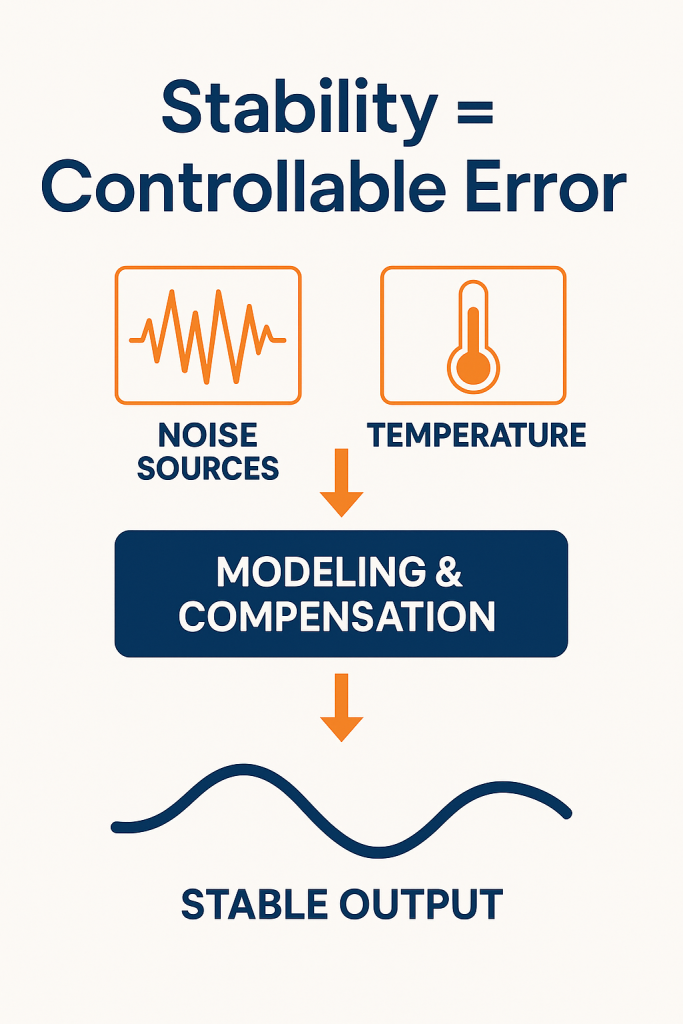
This is why “stability” becomes the primary benchmark for evaluating an IMU. Yet stability does not mean absence of motion — it means controllability of output error.
A truly automotive-grade IMU does not eliminate fluctuations; it makes every fluctuation predictable, modelable, and compensable.
This is the foundational principle behind the SUMACO series: making “stability” a constant that algorithms can rely on.
2. The Root of Error: Drift and Noise
IMU output errors primarily stem from two categories of factors:
- Systematic Error — arising from device manufacturing tolerances, scale factor misalignment, bias offset, and temperature-dependent characteristic shifts;
- Random Error — arising from sensor noise, external disturbances, and stochastic drift.
Systematic errors can be corrected through calibration; random noise, however, must be modeled across the time domain.
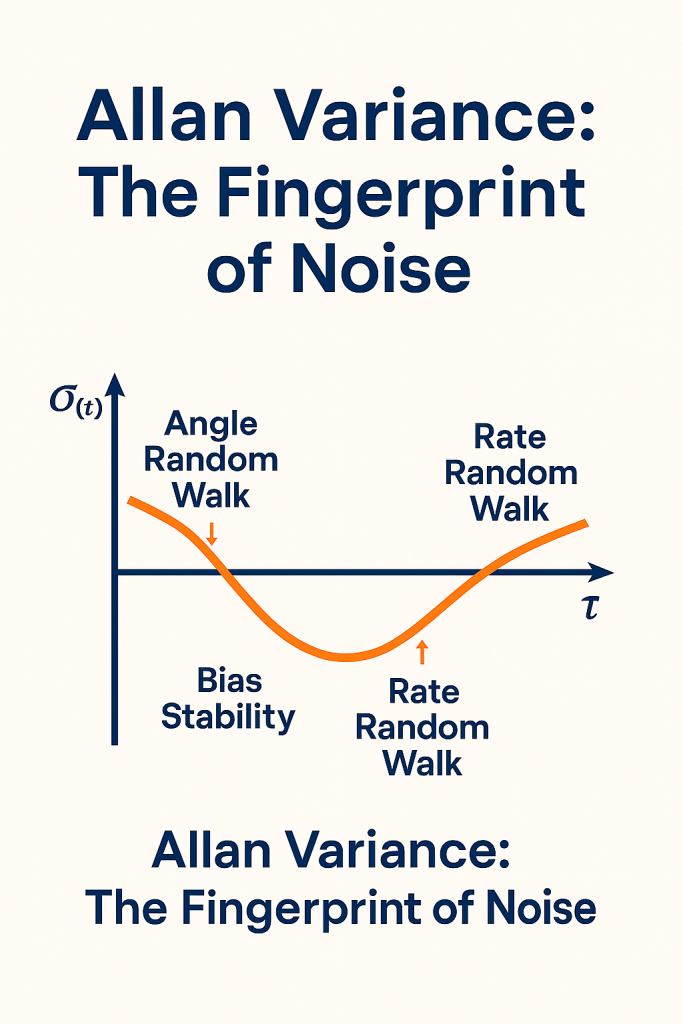
In professional IMU testing, engineers commonly use a technique to characterize noise behavior — Allan Variance Analysis.
Think of it as identifying the rhythm of background noise in a piece of music: by analyzing data across different time intervals, it becomes possible to distinguish and classify noise types.
3. The Temperature Challenge: How Thermal Effects Undermine Stability
Temperature is another adversary of IMU stability.
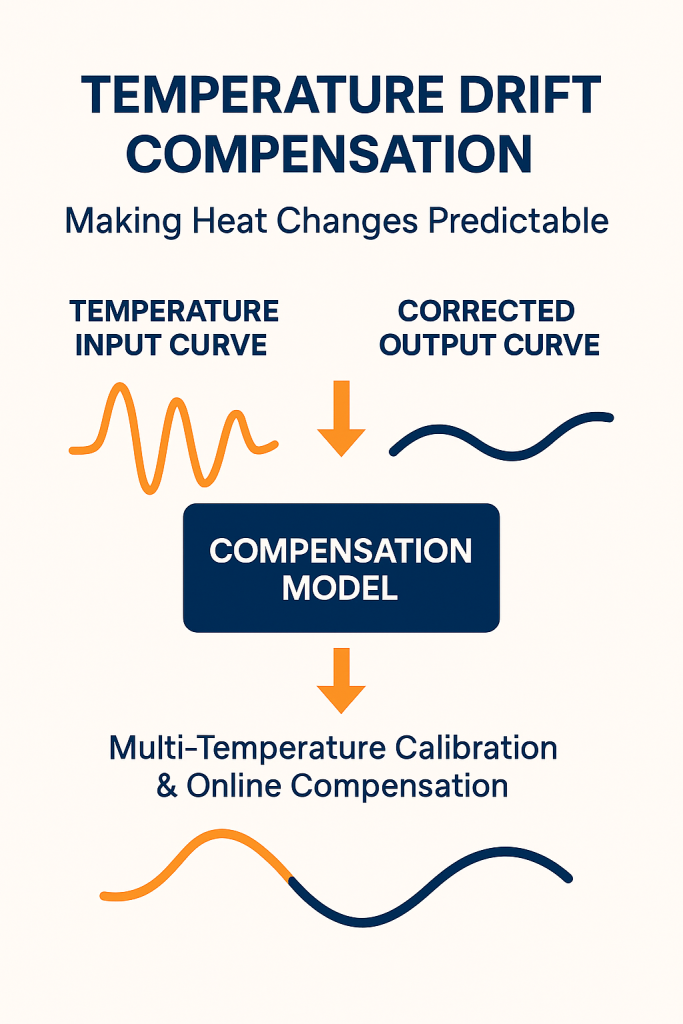
As the operating environment shifts from -40°C in winter to +85°C in summer, the output curves of sensitive elements experience drift.
This “Temperature Drift” causes attitude perception to become inconsistent across high and low temperature extremes.
SUMACO addresses this through a multi-layered approach:
- A high-stability MEMS structure that minimizes material stress variation;
- Multi-Temperature Calibration performed prior to shipment;
- Online Compensation executed in real time during operation.
In other words, SUMACO doesn’t just “know it’s getting hot” — it knows precisely how much heat will affect its output, and corrects for it instantly.
4. From Calibration to Mass Production: The Industrial Logic Behind Stability
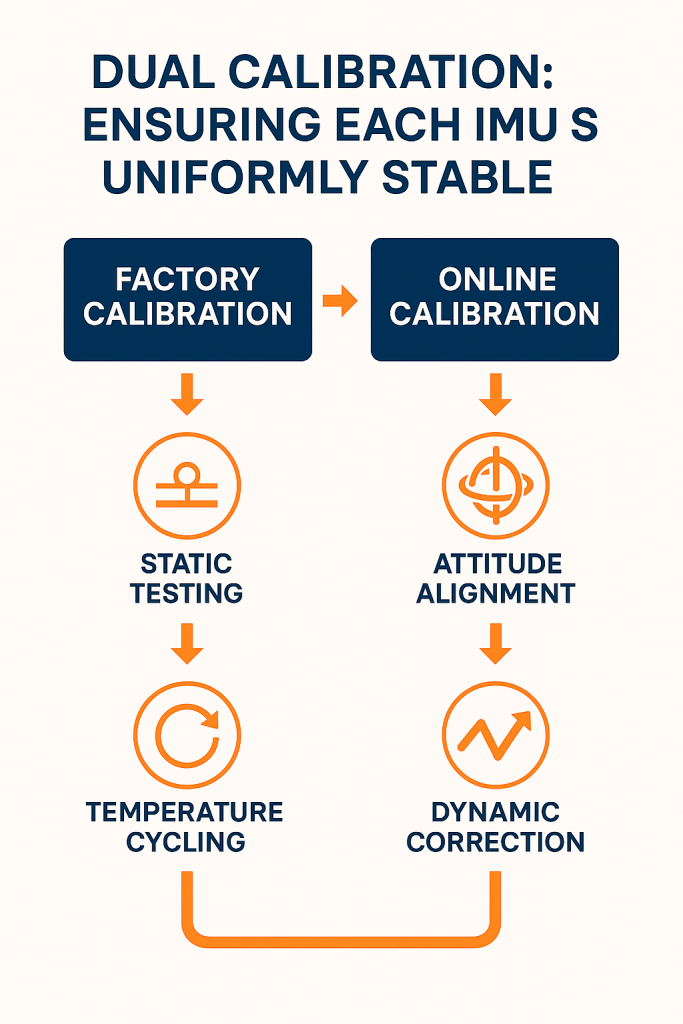
SUMACO’s stability is not the result of any single algorithm — it is the outcome of an integrated industrial system. At our Changzhou Intelligent Manufacturing Center, SUMACO employs a dual-calibration architecture combining factory calibration and online calibration:
- During factory calibration, high-precision turntables and environmental chambers are used to correct bias, scale factor, and cross-axis errors;
- During online calibration, the attitude axis frame is re-aligned after full vehicle assembly to eliminate installation-induced errors.
This two-tier calibration system establishes consistency from the laboratory to real-world deployment —
This is the industrial foundation of an automotive-grade IMU: stability that can be replicated at scale.
5. Stability as a System Capability
True stability is never the result of a single outstanding metric — it is the product of system-level synergy.
SUMACO’s stability is built upon three pillars:
- Automotive-grade hardware design, ensuring physical structural integrity;
- A proprietary calibration system, ensuring error controllability;
- A data closed-loop mechanism, enabling continuous performance evolution.
This represents a deeper form of stability —
Not merely numerical consistency, but epistemic certainty.
When vehicles, robots, or UAVs rely on the attitude data provided by SUMACO,
the world they perceive becomes smoother, more predictable, and more dependable.
About MCT
MCT is an innovative company dedicated to attitude perception and absolute positioning for the Physical AI era. With artificial intelligence at its core, MCT adopts a “data-driven, hardware-software integrated” strategy to develop and deliver comprehensive attitude perception and absolute positioning solutions — serving sectors including embodied intelligence, urban assisted driving, low-altitude economy, robotics, and intelligent devices. Built on proprietary automotive-grade BeiDou high-precision chips and modules, MCT integrates high-precision IMU, vision, and LiDAR sensor technologies with large-scale data assets to provide more reliable, safer, and more accurate technical support for autonomous planning and automatic control, continuously enhancing the spatial perception capabilities of host platforms.
Want to learn more about MCT’s latest developments?
Visit www.mctech.ai / www.mctai.cn, or follow our official WeChat account “毫厘智能 MCT”.