Chapter 4 | SUMACO: A Machine’s Sense of Balance | When Algorithms Learn to “Feel” Direction
Preface: How Do Humans Stay Upright?
Close your eyes and stand on one foot.
You will find that even without vision, you can still maintain your balance.
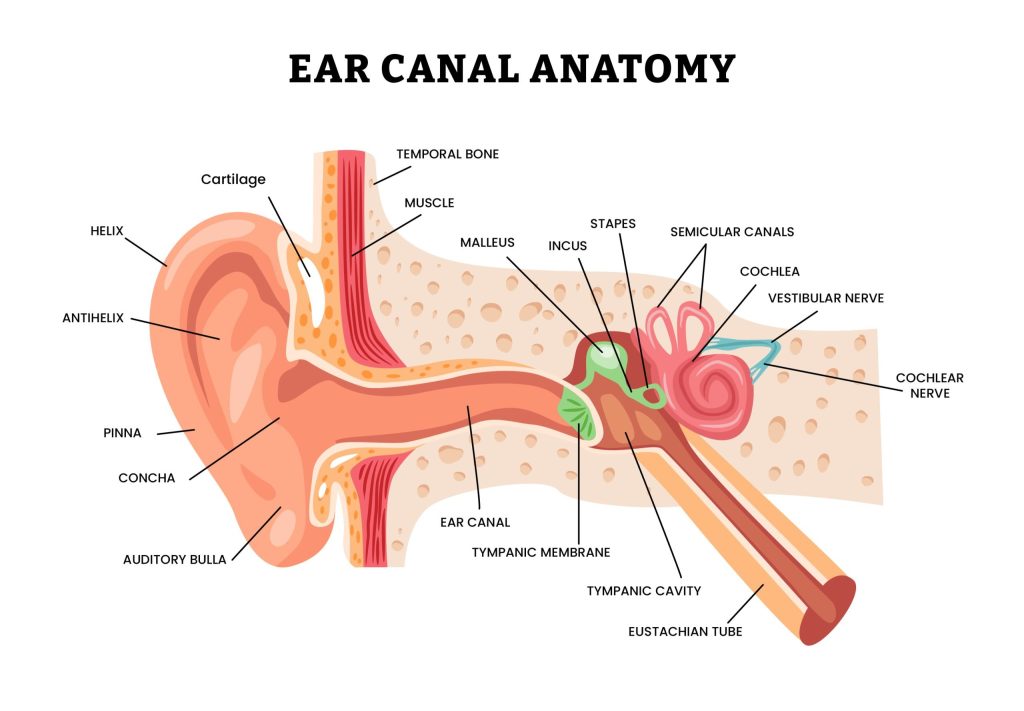
It is not your eyes doing the work — it is the vestibular system of your inner ear, which senses acceleration and angular velocity through the semicircular canals and otolith organs.
For machines, the IMU (Inertial Measurement Unit) serves as that same “inner ear.” It allows a machine to know it is moving, even in places where it cannot see. This is the purpose of SUMACO: to give machines a true sense of balance.
I. From Compass to Gyroscope: The Technological Evolution of Directional Sensing
Early humans relied on the compass to determine direction.
Later, physicists invented the gyroscope — a device capable of maintaining its orientation while spinning.
When you place a rapidly spinning top on a table, it “refuses” to be knocked over;
that is inertia at work.
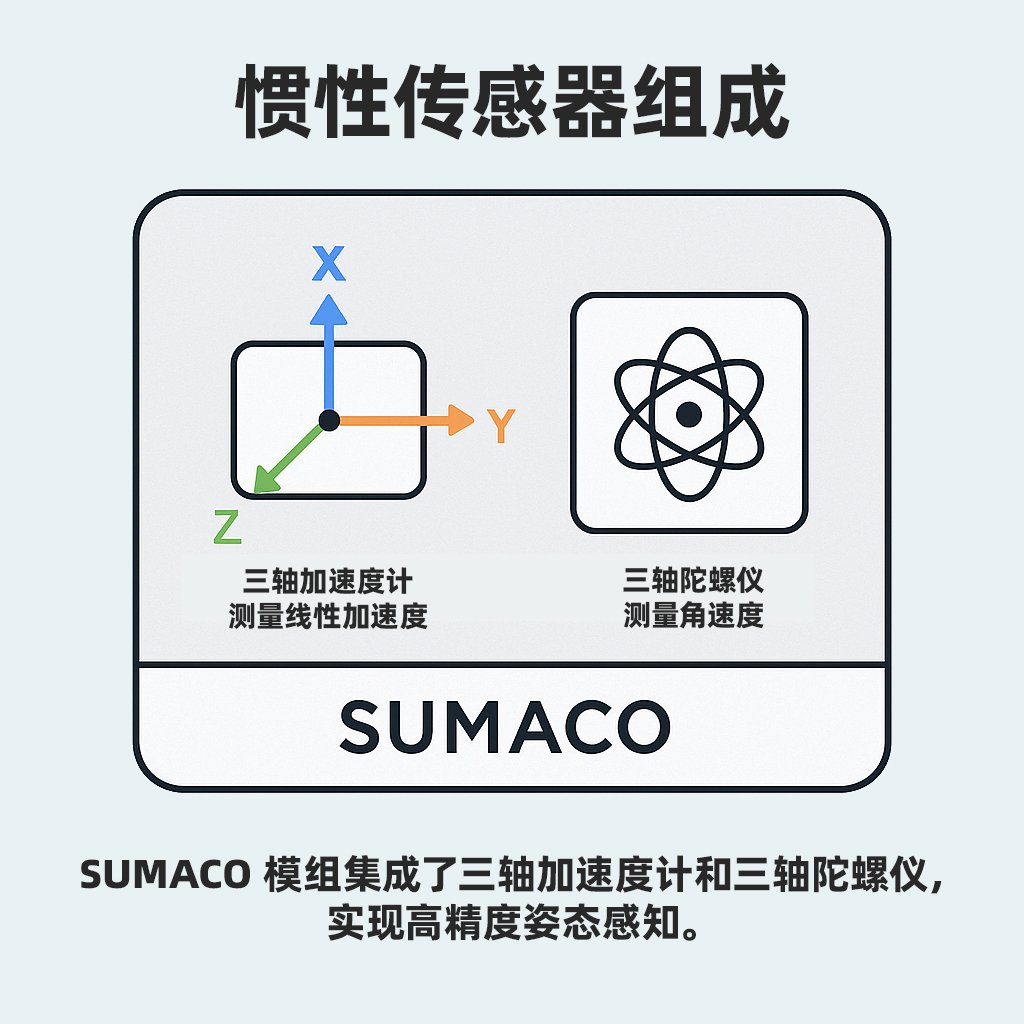
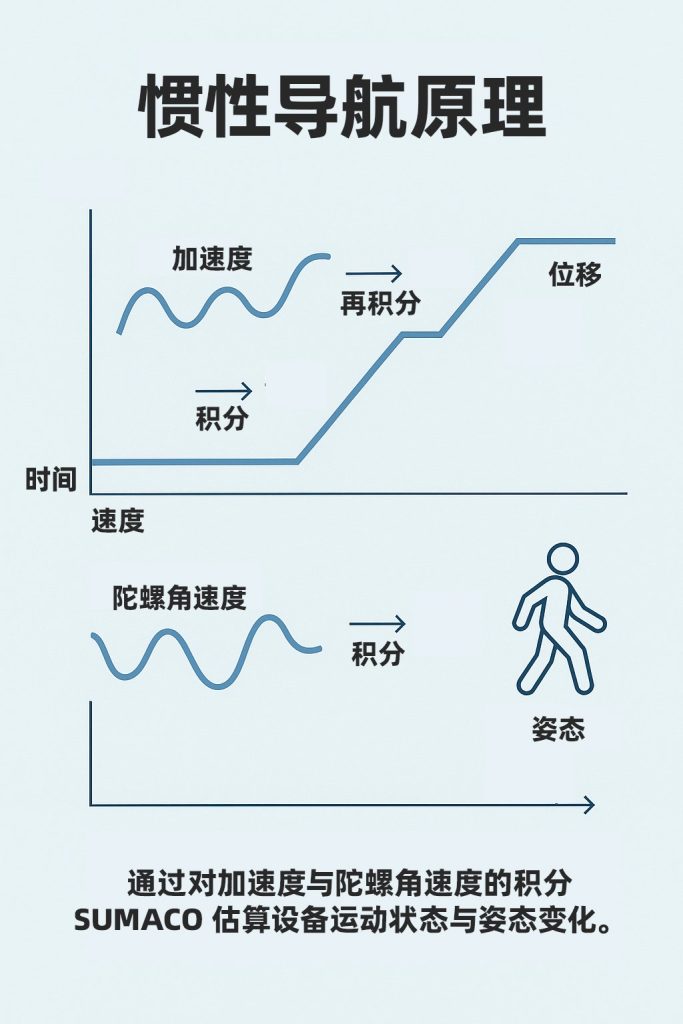
The IMU (Inertial Measurement Unit) packages this same principle into a module no larger than a fingernail. Using three accelerometers and three gyroscopes, it measures linear acceleration and angular velocity across all axes. By continuously integrating these measurements, the system can determine changes in both position and orientation.
II. Drift: The Fundamental Challenge of Inertial Navigation
IMUs have one critical weakness — drift.
Small errors inevitably accumulate during the integration of acceleration and angular velocity measurements,
and as those errors compound over time, the estimated position drifts further and further from reality.
It is like walking with your eyes closed — the deviation may be small at first,
but the longer you walk, the further you stray from your intended path.
The value of a high-performance IMU lies not in eliminating error entirely, but in making drift as slow and as predictable as possible.
SUMACO employs automotive-grade MEMS sensors
and achieves stable output across varying environments through temperature compensation, bias calibration, and error modeling.
This enables continuous trajectory maintenance even during brief GNSS signal outages.
Not perfect — but dependable.
III. SUMACO’s Calibration Philosophy: Making Errors Predictable
IMU errors are not random.
Much like a person’s habits, they follow their own characteristic patterns.
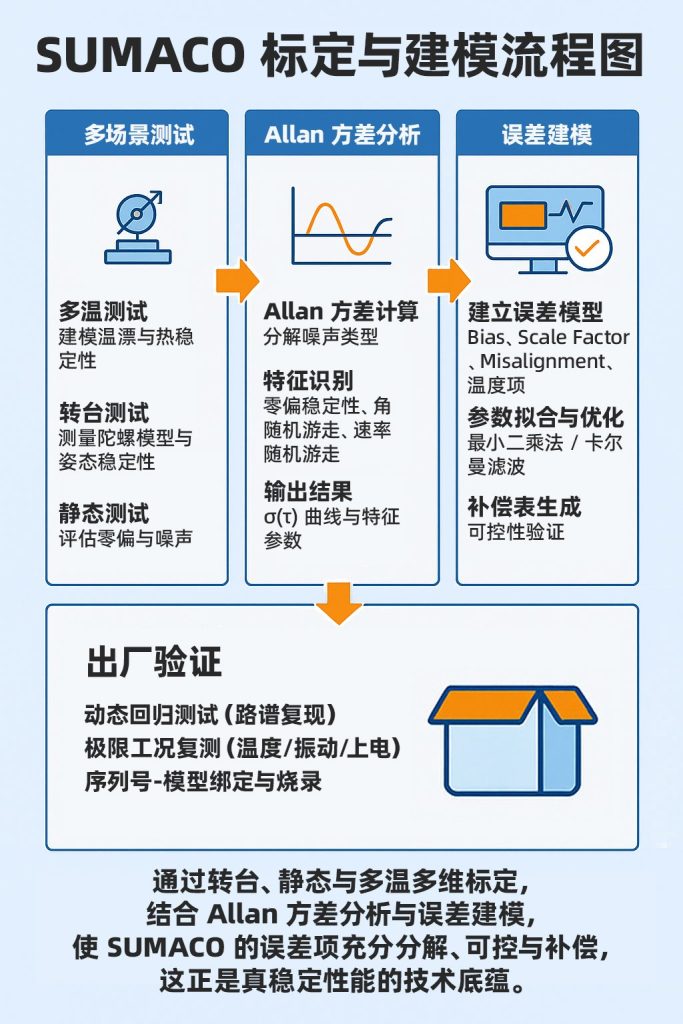
Every SUMACO module undergoes a rigorous multi-temperature, multi-orientation calibration process before leaving the factory.
By modeling bias, scale factor errors, misalignment errors, and noise spectral characteristics,
errors become identifiable and compensable within the algorithm.
This “modelability” represents the critical leap from a standalone sensor to a true system component.
It enables algorithms to apply dynamic corrections at runtime and even leverage historical data for predictive compensation.
This is the data-driven philosophy made tangible at the hardware level.
IV. Integrated Navigation: When the “Inner Ear” Works with the “Eyes”
IMU alone cannot fully eliminate drift.
But when combined with GNSS, vision, and LiDAR, it enables true integrated navigation.
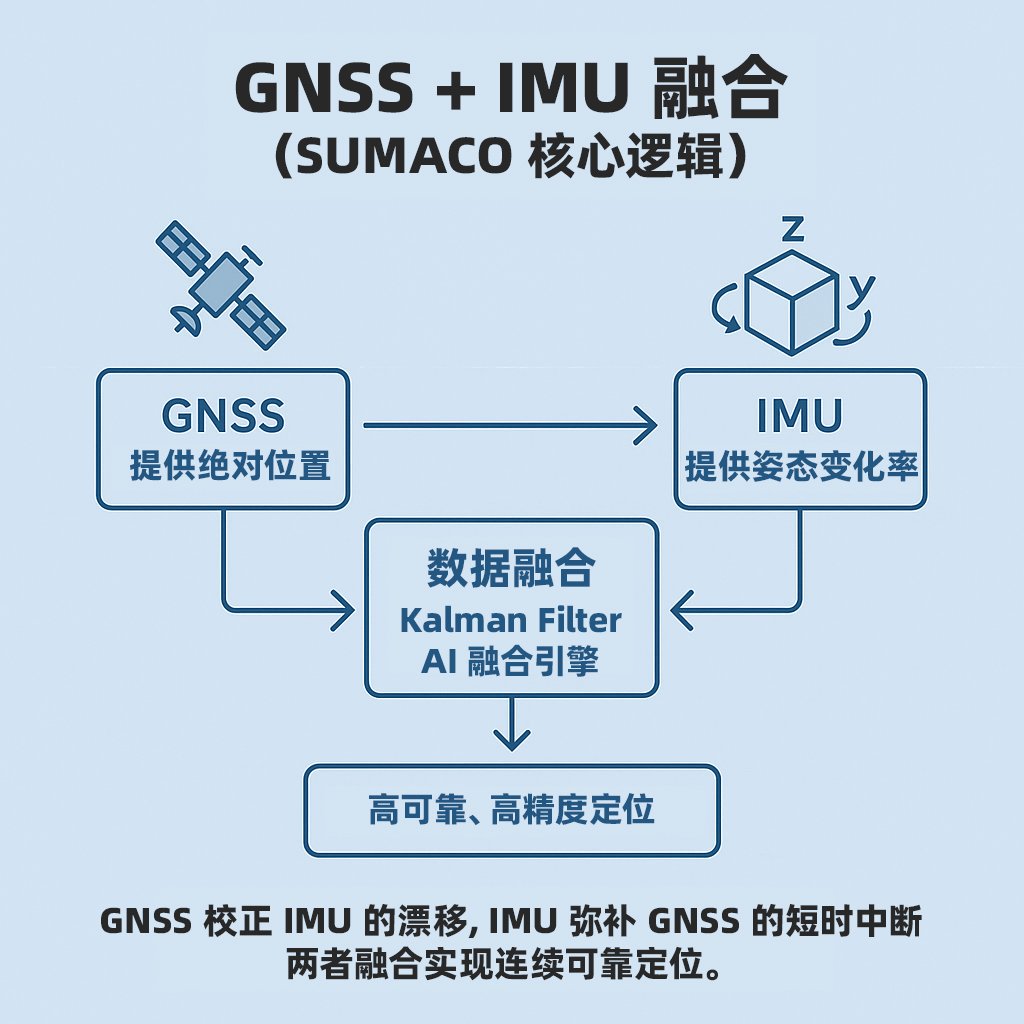
When GNSS signal is strong, the IMU continuously corrects its own drift;
when GNSS signal is temporarily lost, the IMU maintains continuity of attitude and velocity estimation.
Within this architecture, SUMACO serves as the stable core.
It delivers a high-rate, low-noise data stream to the REVENTADOR algorithm engine
and integrates deeply at the system level with MOJANDA’s time synchronization mechanism.
The result is a platform that remains stable and reliable even in highly dynamic environments.
GNSS tells a machine where it is. IMU tells it how it is moving. Only together do they give a machine true spatial existence.
V. SUMACO’s Reliability Philosophy
In MCT’s design philosophy, reliability is not a single metric — it is a system-level behavior.
SUMACO does not merely pursue impressive accuracy figures on a datasheet.
It pursues stability across both the time and spatial dimensions of the entire system.
This means:
- Data that algorithms can trust unconditionally;
- Hardware that withstands temperature extremes and mechanical vibration;
- Seamless integration into the MOJANDA and REVENTADOR ecosystem.
This tightly integrated hardware-software architecture makes SUMACO the machine’s “stabilizer” —
enabling machines not only to move accurately,
but to move with confidence.
VI. Reflection and Outlook
The human sense of balance is innate.
A machine’s sense of balance must be engineered.
From early mechanical gyroscopes to today’s MEMS inertial navigation modules,
humanity is rebuilding the sense of direction in silicon.
As AI deepens its understanding of the physical world,
the IMU will no longer be merely a sensor — it will become an integral part of the machine’s body.
At that point, machines may truly begin to “feel” their own existence.
When algorithms learn to feel direction, spatial intelligence finally gains a soul.
Further Reading
- Titterton & Weston: Strapdown Inertial Navigation Technology
- Paul D. Groves: Principles of GNSS, Inertial, and Multisensor Integrated Navigation Systems
- Noureldin et al.: Fundamentals of Inertial Navigation and Their Integration
About MCT
MCT is an innovative company dedicated to attitude sensing and absolute positioning for the era of Physical AI. With artificial intelligence at the core of our technology, we follow a “data-driven, hardware-software integrated” strategy to develop and deliver comprehensive attitude sensing and absolute positioning solutions. We serve industries including embodied intelligence, urban-area assisted driving, low-altitude economy, robotics, and smart devices. Built on our proprietary automotive-grade BeiDou high-precision chips and modules, and fusing high-precision IMU, vision, and LiDAR sensor technologies with large-scale data, MCT provides more reliable, safer, and more accurate technical support for autonomous planning and automatic control — continuously enhancing the spatial awareness capabilities of intelligent platforms.
Want to learn more about MCT’s latest developments? Visit www.mctech.ai / www.mctai.cn, or follow our WeChat Official Account “毫厘智能 MCT”.