SUMACO | Allan Variance: The Audible Noise Fingerprint of an IMU

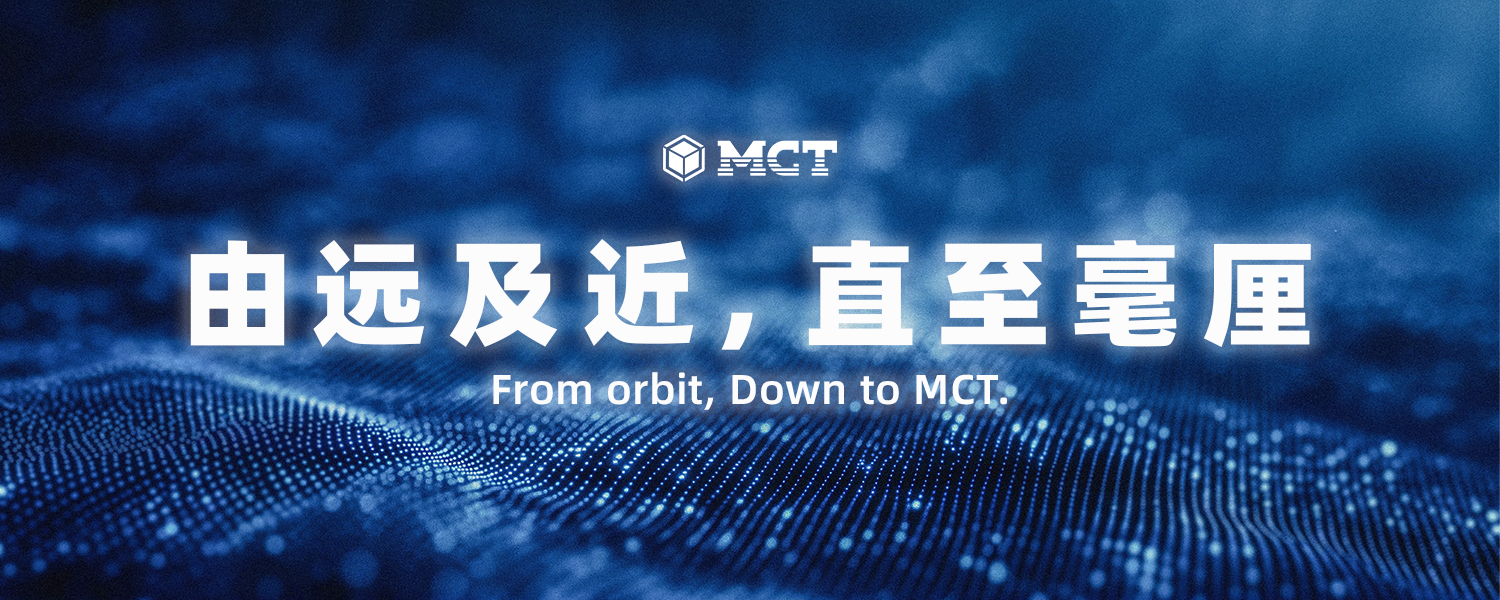
I. Hearing the Rhythm of Noise in a Static Signal
If you imagine an IMU as an “ear that listens to the world,”
then Allan Variance is what helps it identify the noise it hears.
In the lab, engineers often let an IMU sit completely still for hours or even days —
not to see how accurately it tracks motion, but to hear how steadily it holds still.
Every data point an IMU outputs contains noise: fast and slow, light and heavy.
Allan Variance stretches and compresses time to observe how errors evolve over different intervals.
It is not concerned with “the error right now” — it is concerned with “the rhythm of the error.”
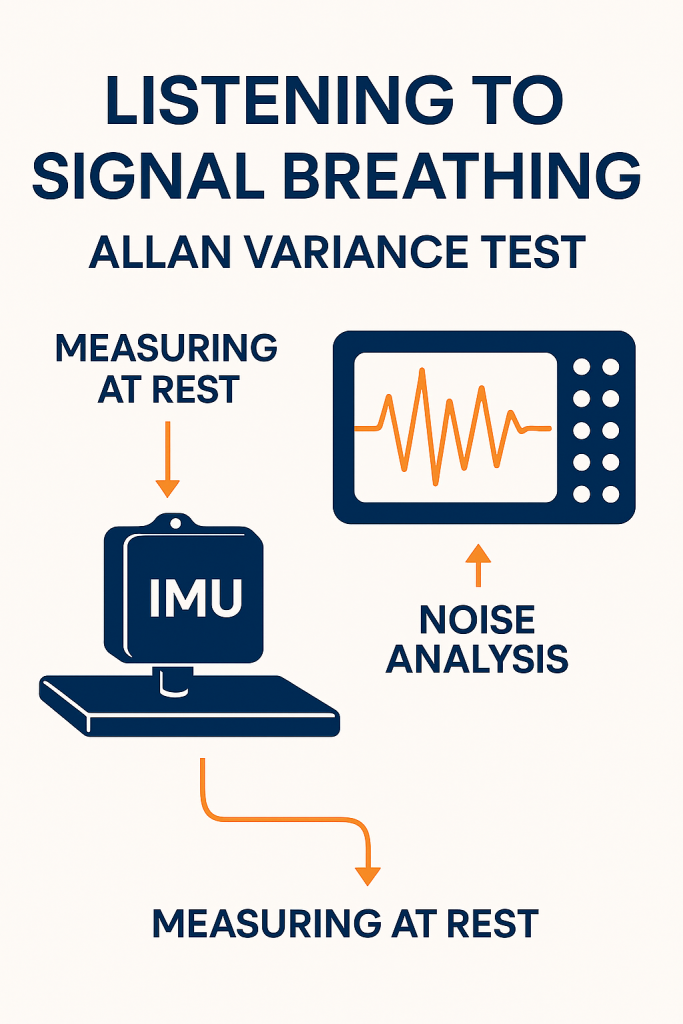
II. What Exactly Is Allan Variance?
Allan Variance is a statistical tool used to distinguish between different types of random noise.
It analyzes the fluctuation characteristics of a signal over time by computing the variance of averages across adjacent time intervals.
In simple terms:
- If the error changes rapidly, it is likely dominated by Random Walk;
- If the error changes slowly but steadily, it is likely Bias Drift.
The horizontal axis of an Allan Variance plot is the averaging time interval τ (tau),
and the vertical axis is the deviation σ(τ).
Different noise types produce distinct slopes on the curve — much like frequency signatures in an audio spectrum.
Every noise type has its own unique “voiceprint.”
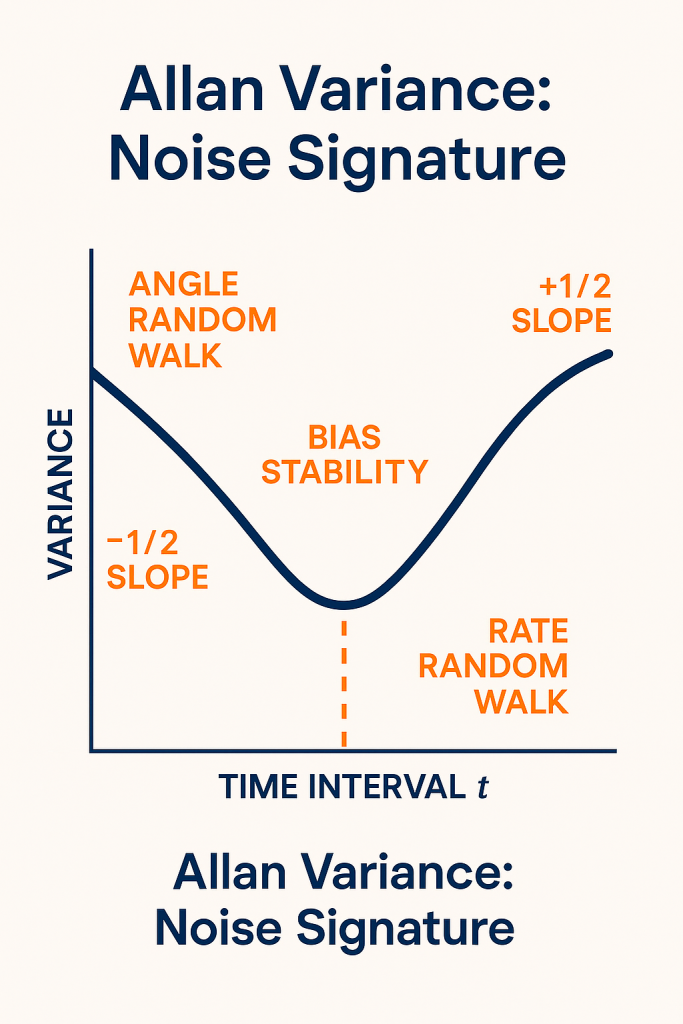
III. Reading the “Noise Genealogy” from the Curve
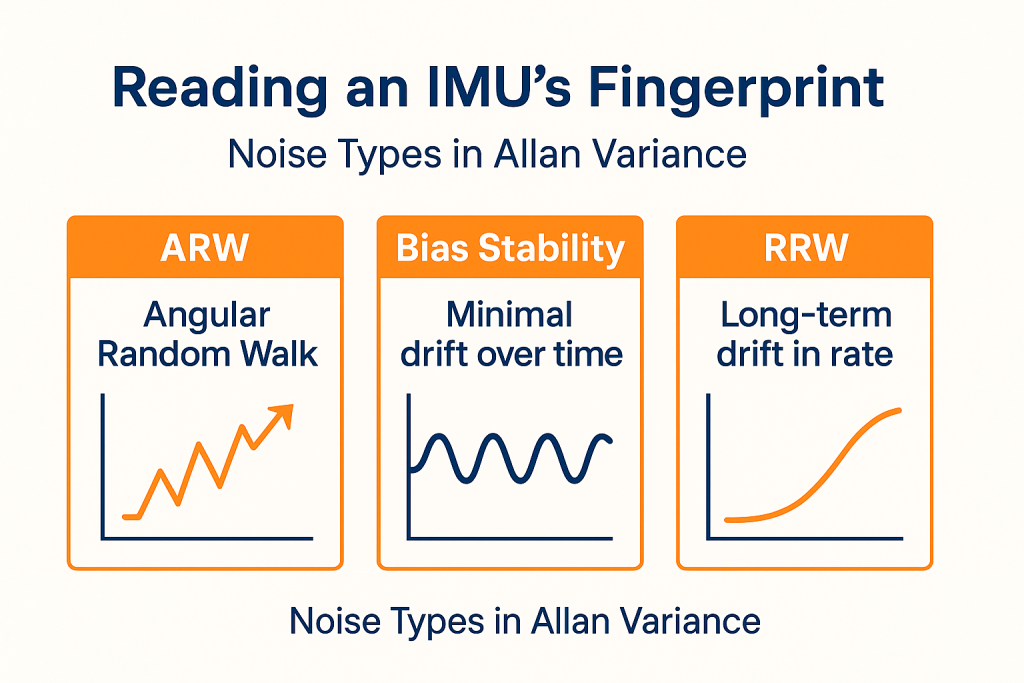
In an Allan deviation curve, different noise types typically exhibit distinct slope characteristics:
- Angular Random Walk (ARW): Reflects short-term random jitter dominated by white noise in the sensor, corresponding to a slope of -1/2;
- Bias Stability: Reflects the degree to which the bias remains stable over medium to long time scales, typically appearing near the minimum point or the approximately flat region of the curve;
- Rate Random Walk (RRW): Reflects the cumulative trend of long-term drift, corresponding to a slope of +1/2.
For engineers, this curve is like the IMU’s “fingerprint” —
you can read its innate capability (sensor noise floor) and behavioral tendencies (drift characteristics),
and even predict how it will perform across different operating environments.
IV. Why It Is Critical for Automotive-Grade IMUs
For automotive-grade IMUs, stability is not an abstract concept — it must be quantified and reproducible.
Allan Variance gives that “stability” an objective standard:
- It evaluates consistency across different production batches;
- It quantifies the effectiveness of algorithmic compensation;
- It assesses the impact of environmental factors such as temperature and vibration on accuracy.
Within SUMACO’s production framework, Allan Variance is not merely a test tool —
it serves as the foundation for product definition and quality control.
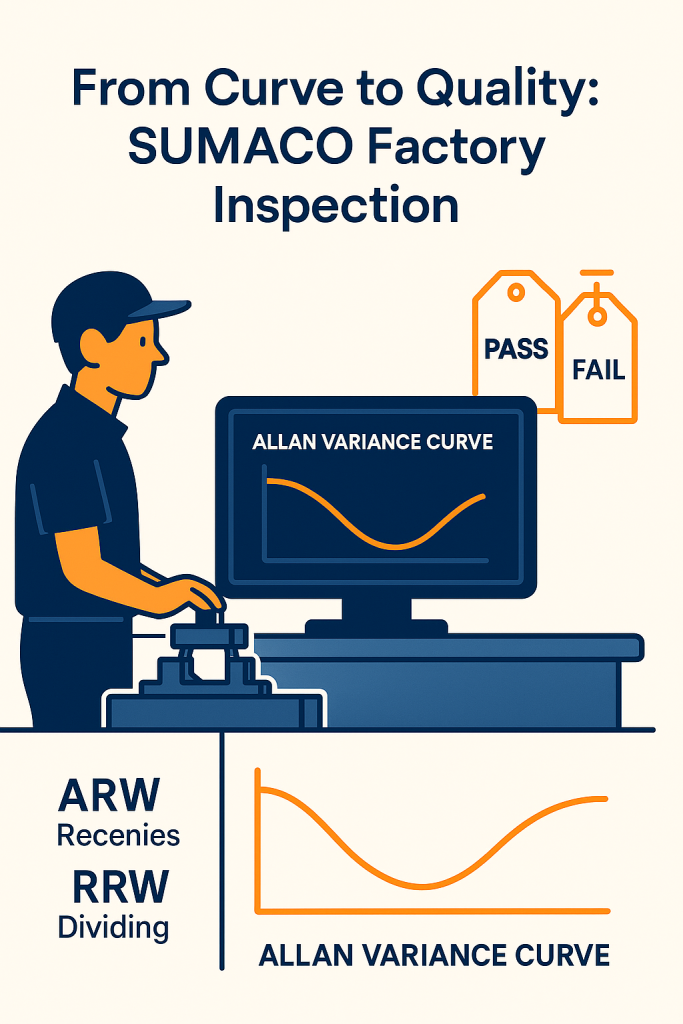
Every SUMACO MA-series module undergoes Allan Variance evaluation before leaving the factory,
ensuring that the noise spectral profile aligns with the defined standard — this is what we call “traceable stability.”
V. Building Trust Over Time
The significance of Allan Variance goes beyond identifying noise — it is about understanding stability over time.
It tells us: stability is not a single moment, but an order built through long-term accumulation.
Just as a driver trusts the continuity of navigation, the “steadiness” of an IMU comes from this same commitment to time.
Behind every Allan deviation curve lies the effort of countless measurements and calibrations —
so that every vehicle and every robot, even amid the noise of time,
can still maintain a clear sense of direction.
About MCT
MCT is an innovative company focused on attitude sensing and absolute positioning for the era of Physical AI. With artificial intelligence as our core technology and a strategy built on “data-driven, software-hardware integration,” we develop and deliver comprehensive attitude sensing and absolute positioning solutions — serving fields including embodied intelligence, urban assisted driving, low-altitude economy, robotics, and smart devices. Built on our proprietary automotive-grade BeiDou high-precision chips and modules, and integrating high-precision IMU, vision, and LiDAR sensor technologies with large-scale data, MCT provides more reliable, safer, and more precise technical support for autonomous planning and automatic control, continuously enhancing the spatial awareness capabilities of mobile platforms.
Want to learn more about MCT’s latest developments?
Visit www.mctech.ai / www.mctai.cn, or follow our WeChat Official Account: “毫厘智能 MCT”.