Chapter 6 | REVENTADOR: Smarter Data Through Algorithms That Understand the World

Prologue: A Tale of Two Vehicles

At the same intersection,
two autonomous vehicles travel side by side.
Both are equipped with high-precision GNSS, IMU, radar, and cameras.
But when they pass through a shadowed zone and the signal is briefly lost,
Vehicle A experiences a slight trajectory drift,
while Vehicle B passes through smoothly — without so much as a fluctuation in speed.
The difference is not in the hardware. It is in the algorithm. Vehicle B’s system is powered by REVENTADOR — a “fusion brain” capable of understanding data, assessing reliability, and actively correcting errors.
A machine’s intelligence lies not in how much it can compute, but in how much it can understand.
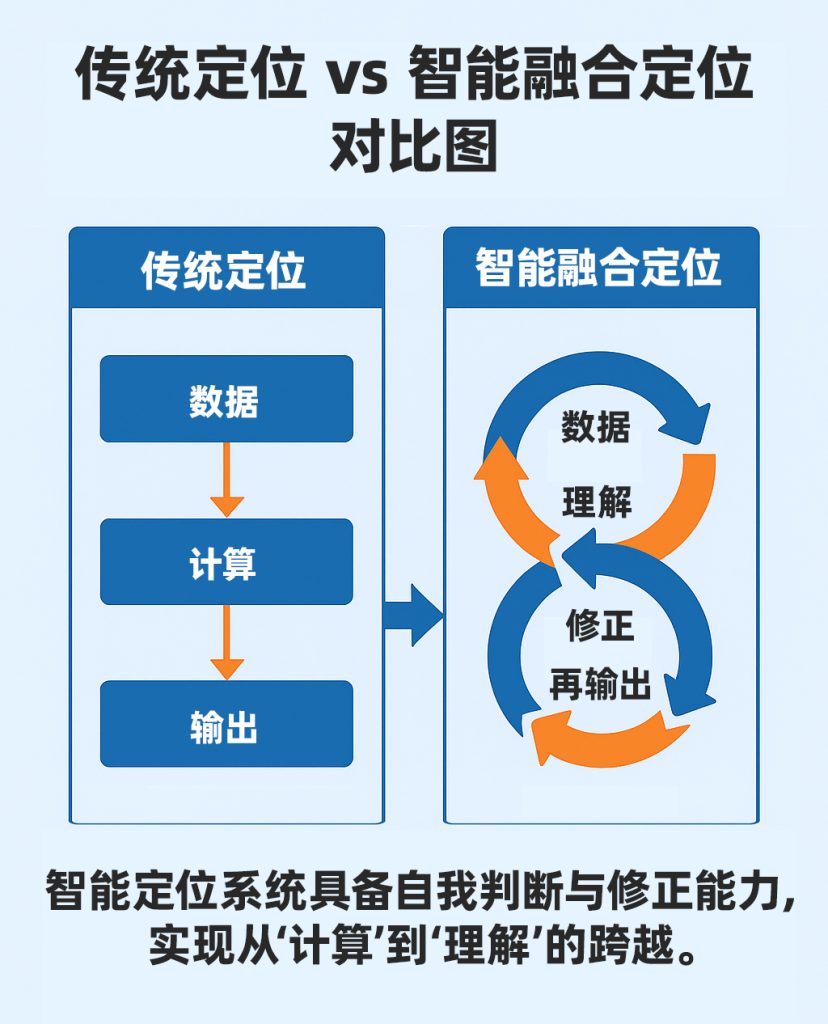
I. Why Data Needs to Be Smarter
The core logic of traditional positioning systems is straightforward: collect → compute → output. This model is simple — but equally fragile. The moment data goes wrong, the output fails.
In embodied intelligence systems such as autonomous vehicles, robots, and drones, positioning is part of a closed loop. It must be capable of self-evaluation, self-correction, and continuous adaptation.
Hardware alone cannot achieve this.
The algorithm must be able to judge the quality of the data it receives.
That is the mission of REVENTADOR.
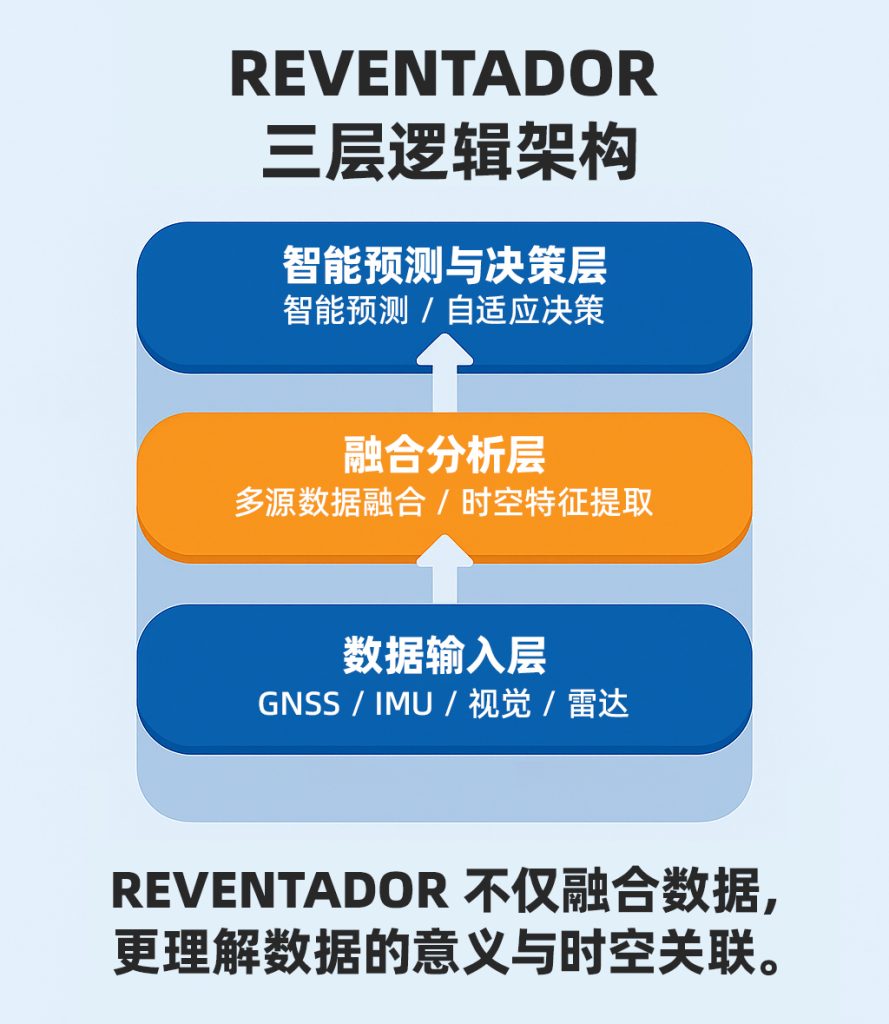
II. REVENTADOR’s Core Logic: Understand, Fuse, Predict
At the heart of the REVENTADOR platform is a multi-layered data intelligence system.
It does not simply fuse data from GNSS, IMU, vision, and radar sensors —
more importantly, it understands the logical relationships between them.
- Understanding
Every sensor has its strengths:
- GNSS excels at providing absolute position;
- IMU responds with exceptional speed to short-term dynamic changes;
- Vision and radar identify surrounding structural features.
REVENTADOR uses algorithms to characterize each sensor’s data profile,
knowing “when to trust which source” —
the first foundation of reliable positioning.
- Fusion
Data from multiple sensors is time-synchronized and spatially aligned,
then fed into the fusion core.
This leverages both tightly coupled and deeply coupled architectures:
- Tightly Coupled integration directly incorporates raw observations at the filter level;
- Deeply Coupled integration enables real-time complementary error correction between GNSS and IMU dynamics.
This fusion approach allows the system to maintain high-precision output even in complex environments.
- Prediction
The fused model develops an understanding of environmental features and motion trends,
enabling it to anticipate future states.
This gives the system a degree of forward-looking awareness —
no longer merely reacting, but anticipating.
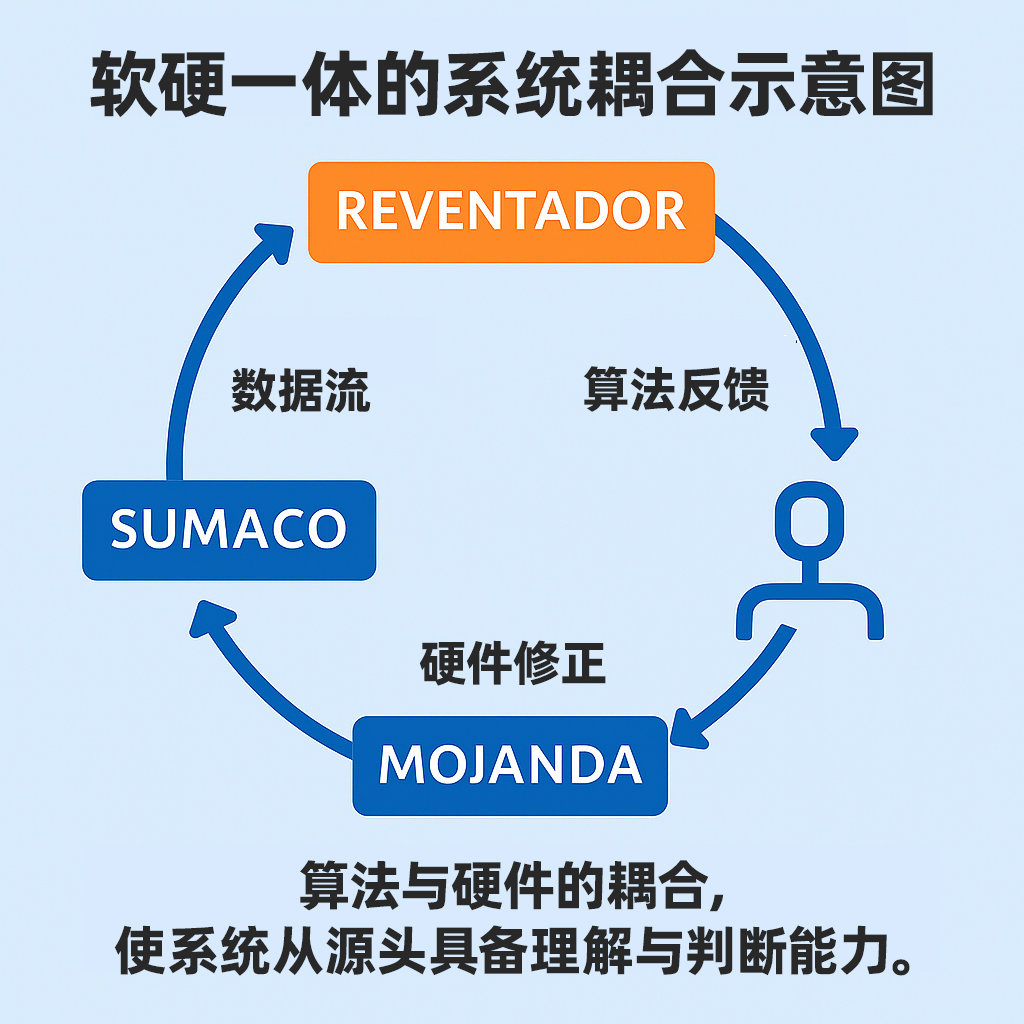
III. Hardware-Software Integration: Bringing Algorithms to Life
Even the most sophisticated algorithm depends on stable hardware to deliver results. REVENTADOR achieves its full potential precisely because it is deeply coupled with the MOJANDA GNSS chip and the SUMACO IMU module.
This hardware-software integrated architecture enables simultaneous optimization across three layers:
- Signal Layer: Multi-frequency, multi-constellation inputs ensure robust data sourcing;
- Sensor Layer: The IMU provides high-frequency attitude data;
- Algorithm Layer: REVENTADOR performs dynamic fusion and outlier rejection.
This means the algorithm does not operate “somewhere in the cloud” —
it begins interpreting data at the physical hardware level itself.
Intelligence does not live in the cloud. It lives inside the system.
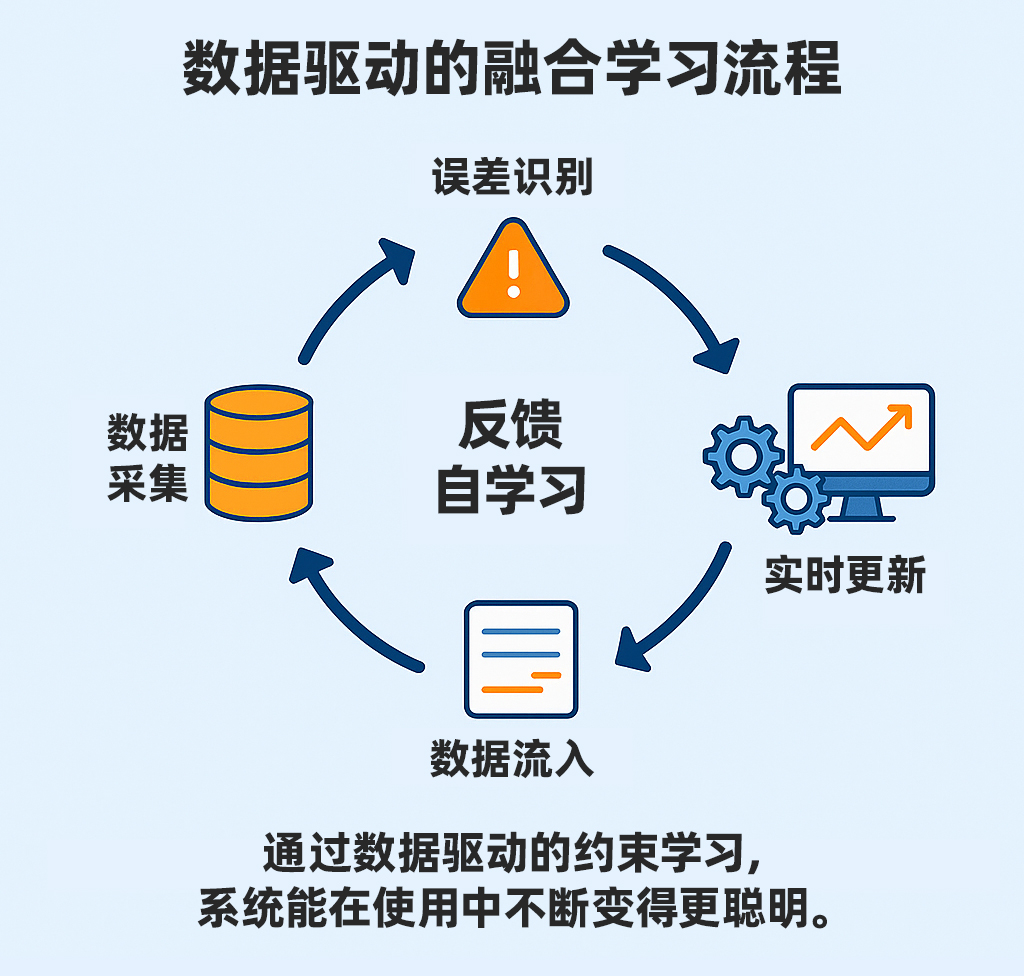
IV. Data-Driven: From Rule-Based to Learning-Based
REVENTADOR adopts a “semi-learning” architecture.
Traditional algorithms rely on manually configured rules — fixed filter parameters, preset error models —
while data-driven algorithms can automatically refine parameters through exposure to massive operational datasets.
MCT’s engineering team has leveraged hundreds of millions of positioning samples
to train the system to recognize error patterns across diverse scenarios:
- Urban canyons → multipath noise signatures;
- Open suburban areas → satellite visibility models;
- High-speed travel → dynamic drift and attitude deviation trends.
These models are not black-box learning — they are constrained, engineering-grounded learning frameworks.
The algorithm knows what it is learning, and knows when to trust which source.
This is the true meaning of making data smarter.
V. From Fusion to Intelligence: The Future of REVENTADOR
The spatial intelligence of the future will not be a collection of isolated sensors operating independently —
it will be a unified, organic system.
REVENTADOR’s goal is to give positioning systems genuine environmental adaptability:
- The ability to assess whether the current environment is open or obstructed;
- The ability to anticipate impending signal degradation;
- The ability to dynamically adjust its solving strategy for different tasks.
When an algorithm can truly understand its environment,
it is no longer just a tool — it becomes a partner.
At that point, a positioning system will no longer just tell you “where I am” — it will tell you “why I am here.”
VI. Reflection and Outlook
For the past few decades, we have been teaching machines to compute.
For the next few decades, we must teach machines to understand.
REVENTADOR marks the beginning of that transition.
It transforms algorithms from executors into thinkers,
and data from records into insights.
When spatial intelligence truly learns to understand the world,
perhaps we will need to redefine the word “position” —
no longer a set of coordinates, but a way of understanding the world.
When algorithms begin to understand the world, spatial intelligence truly begins.
Further Reading
- Paul D. Groves: Principles of Multisensor Navigation and Sensor Fusion
- Probabilistic Robotics (Thrun, Burgard, Fox)
- Kaplan & Hegarty: Understanding GPS/GNSS: Principles and Applications
About MCT
MCT (毫厘智能) is an innovative company dedicated to attitude sensing and absolute positioning for the era of Physical AI. Powered by artificial intelligence at its core, MCT pursues a “data-driven, hardware-software integrated” strategy to develop and deliver comprehensive attitude sensing and absolute positioning solutions. The company serves sectors including embodied intelligence, urban assisted driving, low-altitude aviation, robotics, and intelligent devices. Built on its proprietary automotive-grade BeiDou high-precision chips and modules, and integrating high-precision IMU, vision, and radar sensor technologies alongside massive datasets, MCT provides more reliable, safer, and more precise technical support for autonomous planning and automated control — continuously advancing the spatial perception capabilities of intelligent platforms.
To learn more about MCT’s latest developments, visit www.mctech.ai / www.mctai.cn, or follow our official WeChat account: 毫厘智能 MCT.