MOJANDA | Triple-Frequency RTK: How It Works and Why It Matters
I. Why Triple-Frequency? — The Limits of Precision Lie in the Signal, Not the Algorithm
You’ve probably heard that RTK positioning can achieve centimeter-level accuracy — but few people ask: why do some RTK systems fix quickly while others seem to never settle?
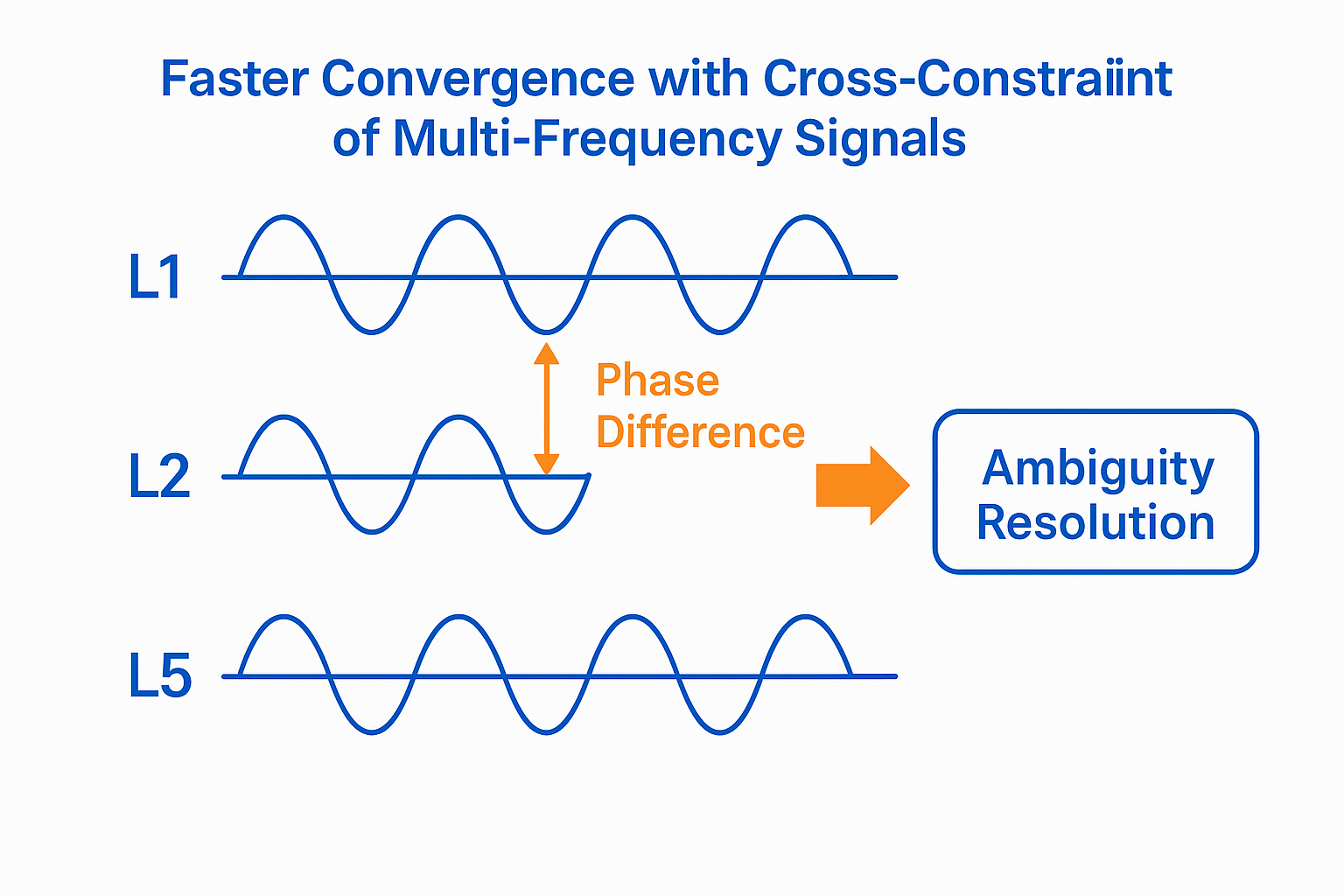
The root cause is this: GNSS accuracy depends on whether the solver can accurately determine the integer number of full carrier wave cycles for each satellite signal. And the key to solving that lies in phase measurement.
Yet phase measurement carries an inherent uncertainty — you can observe where the waveform is at any given moment, but you cannot determine how many complete cycles it has traveled. This is known as the integer ambiguity problem. What RTK does is resolve this integer value through multi-frequency observation, differential techniques, and filtering algorithms.
Resolving ambiguity with single-frequency RTK is like telling time with a single clock. Triple-frequency RTK adds two more clocks, enabling cross-validation of time errors and dramatically faster convergence.
II. What Is RTK: From Phase Measurement to Centimeter Accuracy
RTK (Real-Time Kinematic) is not a piece of hardware — it is a real-time differential positioning technique based on carrier phase measurement.
Its core equation is:
ΔΦ=λ(N+δ)\Delta \Phi = \lambda (N + \delta)ΔΦ=λ(N+δ)
Where:
- ΔΦ is the phase difference measured between two receivers,
- λ is the signal wavelength,
- N is the integer ambiguity (the integer to be resolved),
- δ represents noise and error terms.
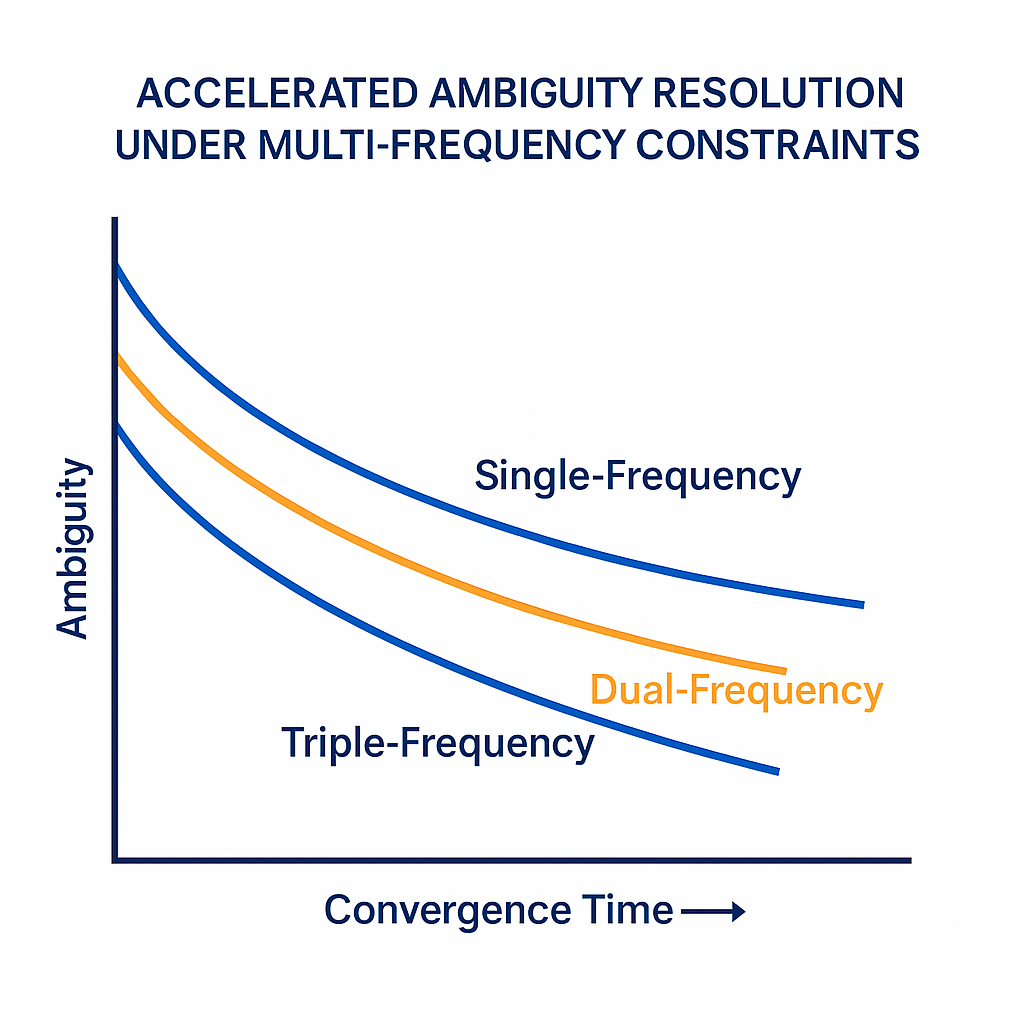
Single-frequency RTK can only set up equations on a single frequency band. Triple-frequency RTK introduces additional observation equations, constructing a multi-dimensional solution network that enables rapid ambiguity fixing even in the presence of multipath interference, poor satellite geometry, and signal obstruction.
Triple-frequency RTK ≈ more independent equations → more stable ambiguity resolution → faster convergence.
III. The Value of Triple-Frequency: Faster, More Stable, More Interference-Resistant
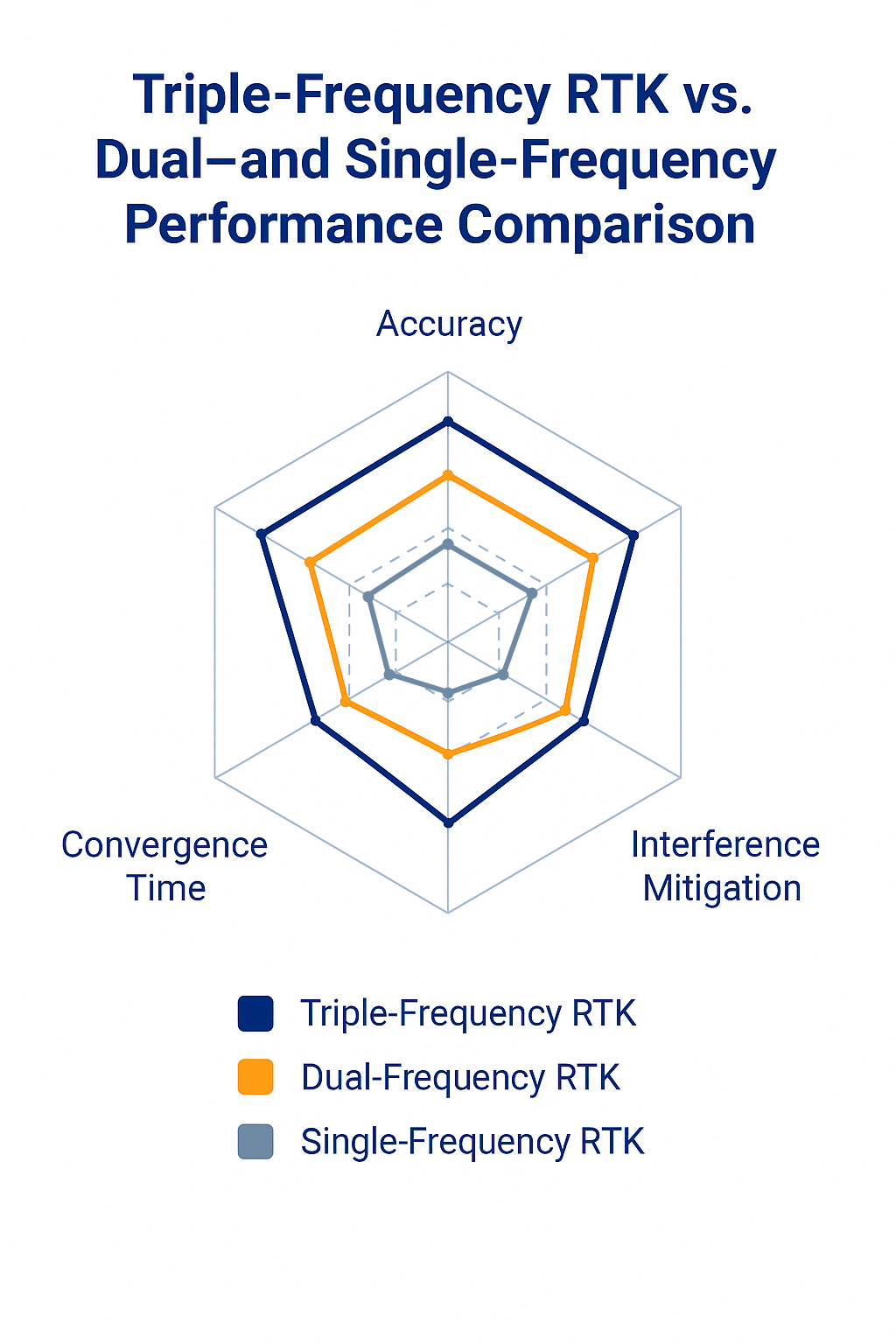
In real-world engineering environments, the value of triple-frequency RTK goes beyond mere accuracy — it is fundamentally about reliability and stability:
- ① Faster convergence: Triple-frequency signals reduce ambiguity resolution time by 30%–50%.
- ② Superior interference resistance: Lower frequencies handle signal obstruction better; higher frequencies resist multipath — together, they achieve spectral-domain compensation.
- ③ More stable positioning: In urban canyon environments or under ionospheric fluctuations, positioning errors are reduced by an average of 40%.
In the MOJANDA chip, all three advantages are achieved through the coordinated operation of a triple-frequency fusion algorithm and adaptive filtering, ensuring positioning that is not only precise, but reliably consistent.
IV. Why Automotive-Grade Applications Demand Triple-Frequency
Automotive-grade application scenarios — autonomous driving, unmanned agricultural machinery, low-altitude aerial vehicles — share one critical requirement: they cannot tolerate delays caused by signal re-acquisition.
Single-frequency GNSS is prone to losing lock in extreme weather, under bridges, or in electromagnetically interfered environments.
Dual-frequency performs better, but can still exhibit instability at high latitudes or in complex scenarios.
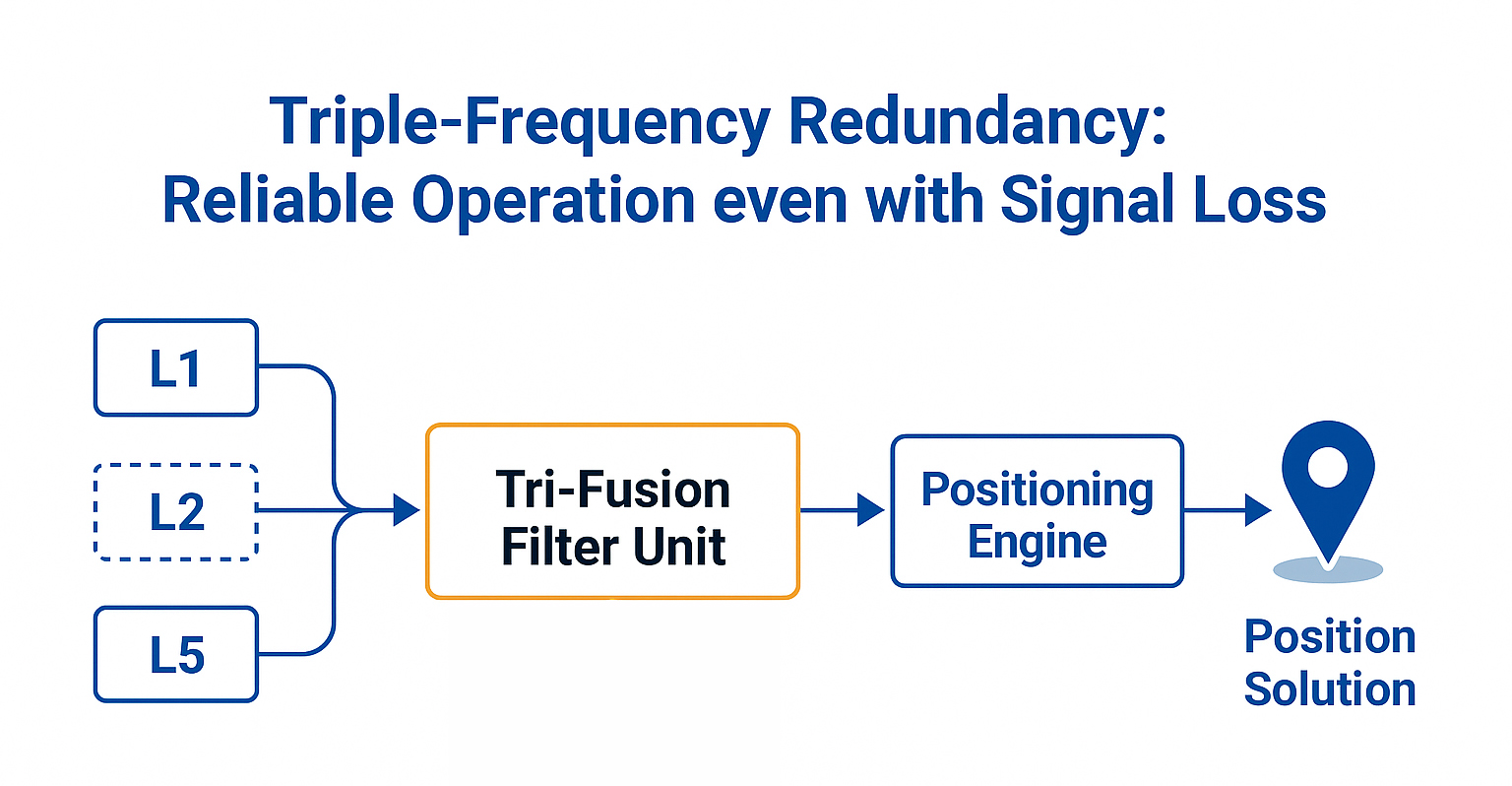
Triple-frequency RTK establishes a reliability loop through multipath redundancy:
- If one frequency loses lock, the system can maintain its solution using the remaining two;
- Synchronization algorithms continuously evaluate signal quality across all frequency bands in real time;
- The MOJANDA chip integrates a built-in Tri-Fusion Filter Unit, enabling dynamic signal weighting that prioritizes the highest-quality frequency band for computation.
In other words, triple-frequency RTK is not just about faster convergence — it is about maintaining the confidence to keep solving even under the most demanding conditions.
V. From Signal to Trust: The Engineering Philosophy Behind Triple-Frequency RTK
Triple-frequency is not a marketing term — it is an expression of engineering discipline. It represents a commitment to facing the uncertainty of the physical world not by relying on a single signal, but by building systems that are capable of self-correction through redundancy and intelligent algorithms.
MOJANDA’s triple-frequency RTK does more than improve accuracy — it enhances the system’s ability to survive and perform in a complex world.
Accuracy solves the problem of “seeing clearly.” Triple-frequency solves the problem of “staying alive.”
This is MCT’s commitment to spatial intelligence:
Through the integration of hardware, software, and data-driven intelligence, we make every coordinate worthy of trust.
About MCT
MCT is an innovative company focused on attitude sensing and absolute positioning for the Physical AI era.
With artificial intelligence at our core, we pursue a strategy of data-driven development and hardware-software integration,
delivering comprehensive attitude sensing and absolute positioning solutions in both hardware and software,
serving industries including embodied intelligence, urban assisted driving, low-altitude aviation, robotics, and intelligent devices.
Built upon our proprietary automotive-grade BeiDou high-precision chips and modules,
we fuse high-precision IMU, vision, and radar sensor technologies with large-scale data,
providing more reliable, safer, and more precise technical support for autonomous planning and automated control,
continuously advancing the spatial awareness capabilities of mobile platforms.
To learn more about MCT and our latest developments, visit www.mctech.ai / www.mctai.cn, or follow our WeChat Official Account: 「毫厘智能 MCT」.