MOJANDA | The Three Pillars of Reliability: Stability, Availability, and Recoverability

由远及近,直至毫厘!Far. Then MCT.
“Precision is a capability. Reliability is a trust.”
1️⃣ Why “Reliability” Matters More Than “Accuracy”
In the GNSS chip industry, the most familiar metric is often “positioning accuracy” — the smaller the error, the more advanced the system. But in real-world engineering environments, accuracy is only the ceiling of performance; reliability is the baseline for survival.
Imagine an autonomous vehicle driving beneath an overpass.
If positioning was once accurate to 2 cm, yet a momentary interference causes signal loss,
the vehicle is still left navigating blind.
Reliability is not about “how accurately you compute” — it is about “whether you can stay stable, stay available, and recover when things go wrong.”
2️⃣ The Three Pillars of Reliability: Stability, Availability, and Recoverability
1️⃣ Stability — Does the system produce smooth, controlled output under complex conditions? This measures whether a system can “hold steady.” In the MOJANDA chip, stability is embodied in its triple-frequency fusion algorithm and anti-interference filtering mechanism, enabling consistent, stable output even in urban canyons or weak-signal environments.
2️⃣ Availability — Can the system stay online continuously, without interruptions or dropouts? This measures whether a system can “keep running.” MOJANDA undergoes extended continuous operation testing and employs a signal health monitoring mechanism to ensure the chip maintains stable service even under high load and complex electromagnetic environments.
3️⃣ Recoverability — When an anomaly occurs, can the system quickly return to normal operation? This measures whether a system can “bounce back.” MOJANDA features a built-in automatic re-initialization and fast re-acquisition mechanism, restoring signal lock within milliseconds after brief occlusion or power loss, ensuring data continuity.
3️⃣ Automotive-Grade Reliability: Holding Steady Under Extreme Conditions
Automotive-grade chips are not laboratory products — they are hardware built to survive in harsh environments. MOJANDA’s reliability validation framework conforms to the AEC-Q100 Grade 2 standard, encompassing several categories of rigorous testing:
- High/Low Temperature Cycling (−40°C to +105°C): Validates stability at thermal extremes;
- Electromagnetic Compatibility (EMC): Ensures stable output in high-interference environments;
- Extended Continuous Operation (72+ hours): Verifies system availability;
- Power-Loss Recovery Testing: Validates that the self-recovery mechanism is predictable and free of accumulated error.
The goal of these validations is not to pursue “absolute accuracy” — it is to ensure that under any condition, the system never fails without warning.
“Consistent output is more valuable than momentary high precision.”
4️⃣ The Algorithmic Foundation of Reliability: Hardware-Software Co-Design
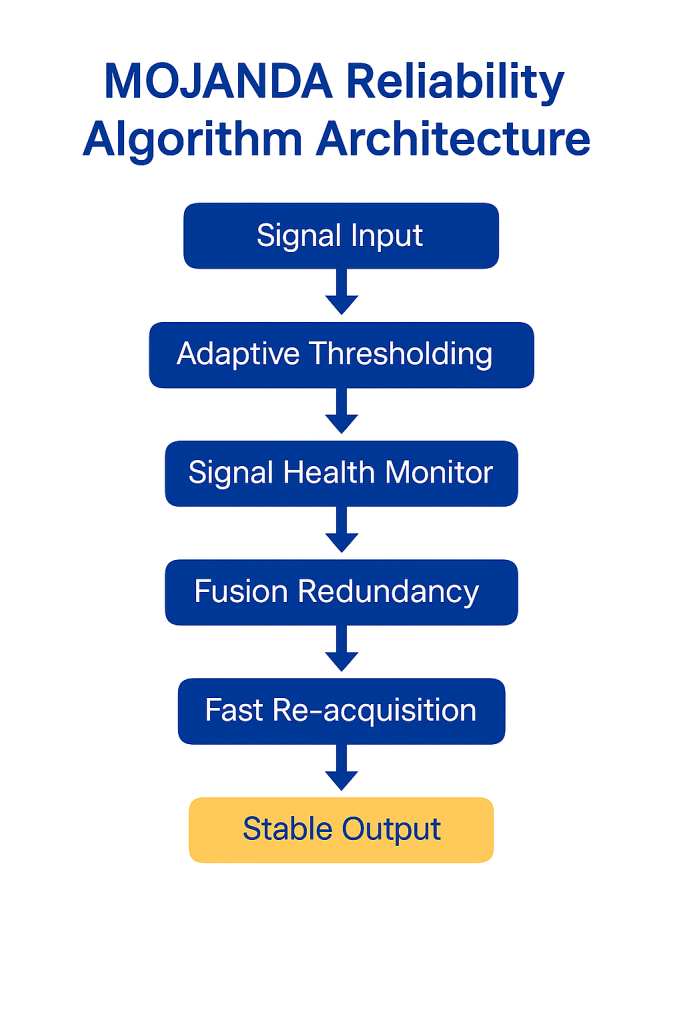
The reliability of the MOJANDA chip stems not only from hardware craftsmanship, but also from coordinated mechanisms at the algorithm layer.
- Adaptive Thresholding: Dynamically adjusts algorithm tolerances in real time based on signal conditions, ensuring stable output even in weak-signal states.
- Signal Health Monitor: Automatically excludes anomalous satellite signals, preventing brief fluctuations from causing solution collapse.
- Fusion Redundancy: When GNSS is briefly interrupted, the system can rely on IMU data to maintain navigation continuity.
- Fast Re-acquisition: After occlusion or power loss, signal lock can be restored within milliseconds, keeping data coherent.
These mechanisms collectively form the algorithmic foundation for recoverability.
MOJANDA’s reliability is not passive defense — it is an active, self-healing capability.
5️⃣ “Reliability” — The Engineering Conviction of the AI Era
In the era of intelligent driving, embodied robotics, and low-altitude aviation,
no matter how intelligent a system becomes, it must be built upon reliable positioning.
Accuracy can be improved through algorithms. Reliability can only be earned through engineering. This is the ethos of automotive-grade GNSS chips —
“Even in the worst conditions, deliver an answer you can depend on.”
MOJANDA represents MCT’s commitment to “hardware-software integration and data-driven innovation”:
through algorithmic redundancy, rigorous validation frameworks, and engineering standards,
empowering spatial intelligence with a truly stable, trustworthy perception foundation.
About MCT
MCT is an innovative company focused on attitude sensing and absolute positioning for the Physical AI era. With artificial intelligence at its core, MCT adopts a “data-driven, hardware-software integrated” strategy to develop and deliver comprehensive attitude sensing and absolute positioning solutions — serving fields including embodied intelligence, urban-area assisted driving, low-altitude aviation, robotics, and smart devices. Built on proprietary automotive-grade BeiDou high-precision chips and modules, and integrating high-precision IMU, vision, and LiDAR sensor technologies with large-scale data, MCT provides more reliable, safer, and more precise technical support for autonomous planning and automatic control, continuously enhancing the spatial perception capabilities of its platforms. Want to learn more about MCT? Visit www.mctech.ai / www.mctai.cn, or follow our WeChat Official Account: “毫厘智能 MCT”.