MOJANDA: The Evolution from Navigation to Reliable Positioning for Automotive Applications

Prologue: The Moment a Vehicle Goes “Blind”
Have you ever noticed?
When a car passes under an overpass or enters a tunnel, the navigation map often “freezes” for a second.
The blue dot drifts slightly. The route deviates.
In everyday driving, this kind of error is a minor inconvenience;
but in the world of autonomous driving, even a ten-centimeter deviation can be catastrophic.
For machines to “see the road and judge their position” the way a human driver does, vehicles need more than just positioning — they need reliable positioning.
I. What Automotive-Grade Positioning Really Means: Not Higher Specs, But Stricter Standards
Automotive grade doesn’t simply mean one tier higher in performance specifications —
it means a product must remain reliable under the most demanding conditions imaginable.
An automotive-grade GNSS chip must withstand:
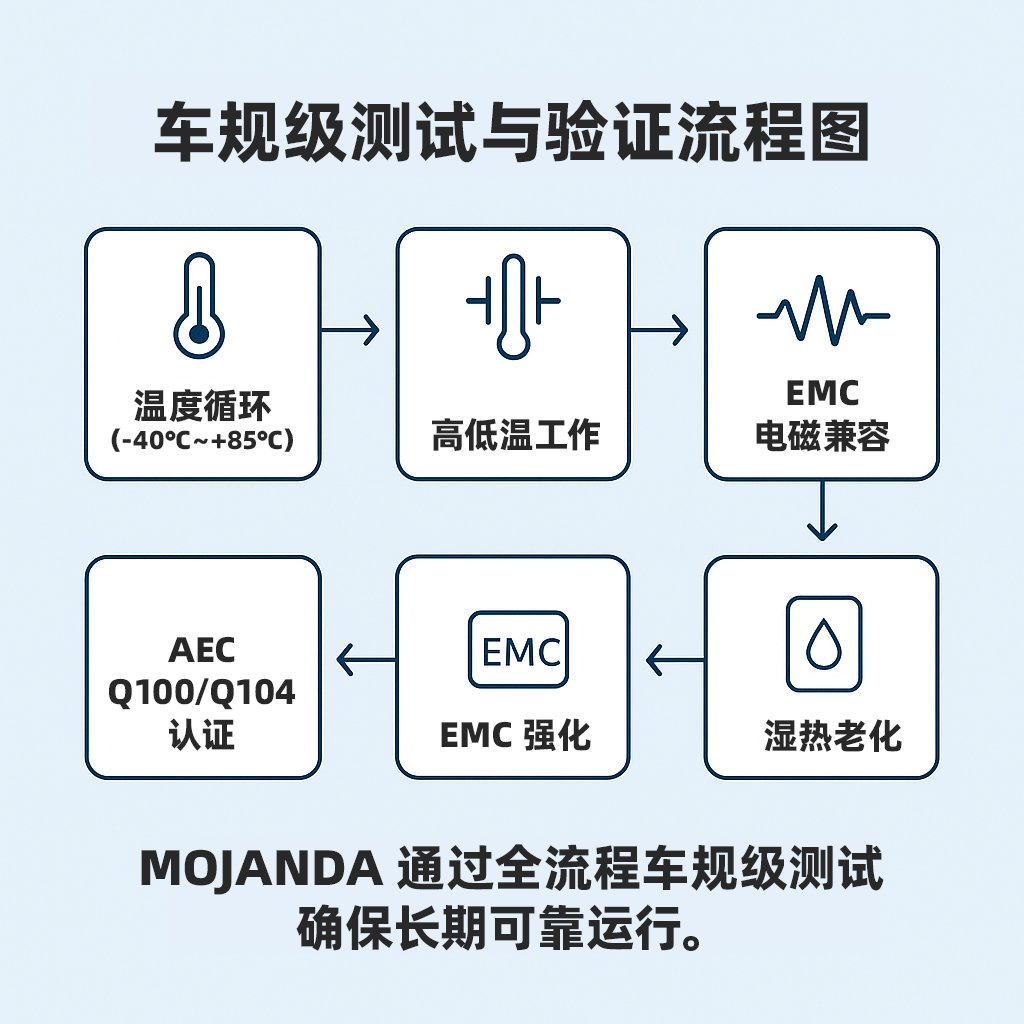
- More than 1,000 hours of thermal cycling tests (–40°C to +85°C);
- Validation under the AEC-Q100/104 certification framework;
- Continuous testing for vibration, humidity, power consumption, and redundancy safety.
These standards ensure the chip continues to deliver accurate results in rain, snow, extreme heat, dust, and electromagnetic interference. It pursues not only precision, but stability and consistency — the fundamental requirements for survival in the automotive world.
II. From “Accuracy” to “Reliability”: A Dual-Engine Philosophy
The mission of a GNSS chip is not simply to “provide positioning.” It must position correctly at all times.
Conventional chips emphasize “accuracy” — minimizing error as much as possible;
but in the real world, signals can be jammed, obstructed, or reflected.
In those moments, whether the system can detect and correct errors is the true differentiator.
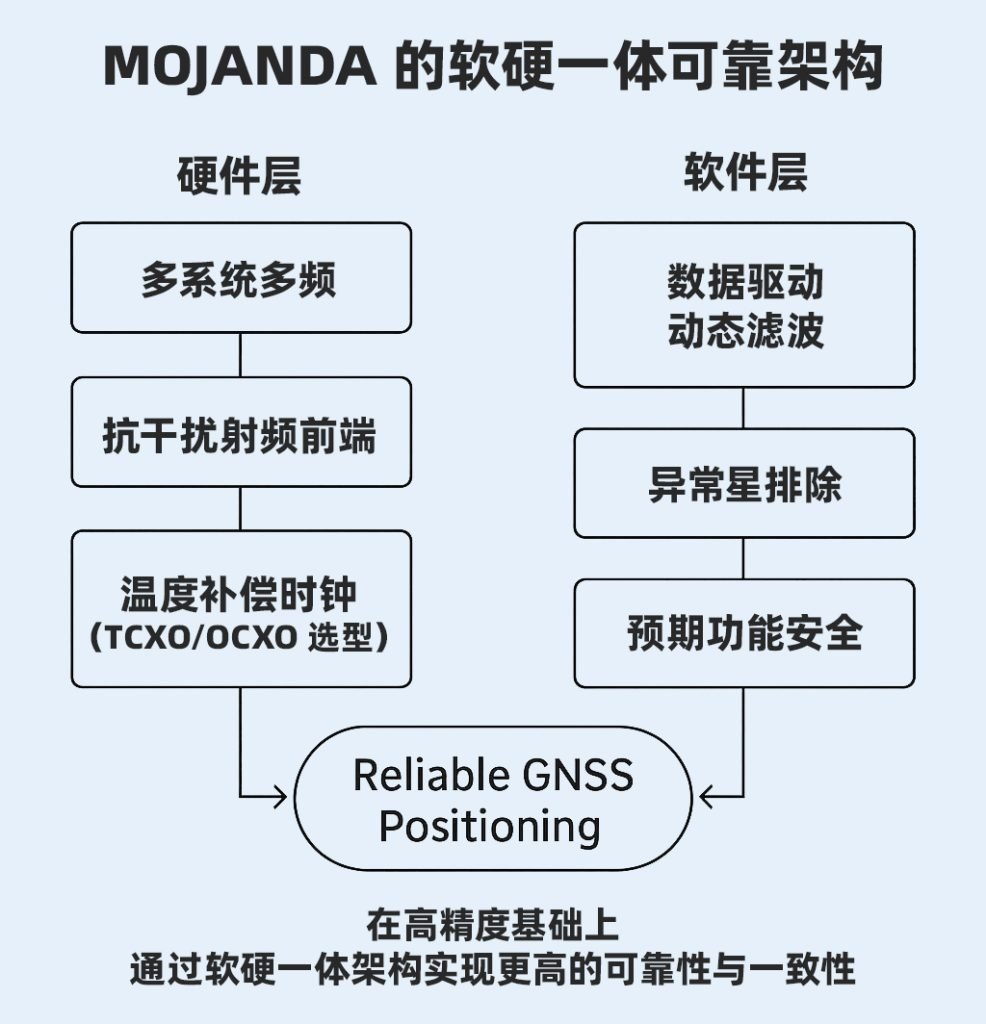
MOJANDA’s core value lies in this: it builds reliability on top of accuracy. This is reflected on two levels:
- Hardware-level reliability:
- Multi-constellation, multi-frequency reception (GPS, BeiDou, Galileo, GLONASS);
- Interference-resistant RF design;
- Sustained clock stability even at high temperatures.
- Software-level reliability:
- Data-driven dynamic filtering algorithms;
- Automatic detection and exclusion of anomalous satellite signals;
- Collaborative operation with SUMACO and REVENTADOR for multi-source correction.
This integrated hardware-software architecture enables centimeter-level output even in complex urban environments.
III. The Essence of Reliability: Consistency Over Instantaneous Accuracy
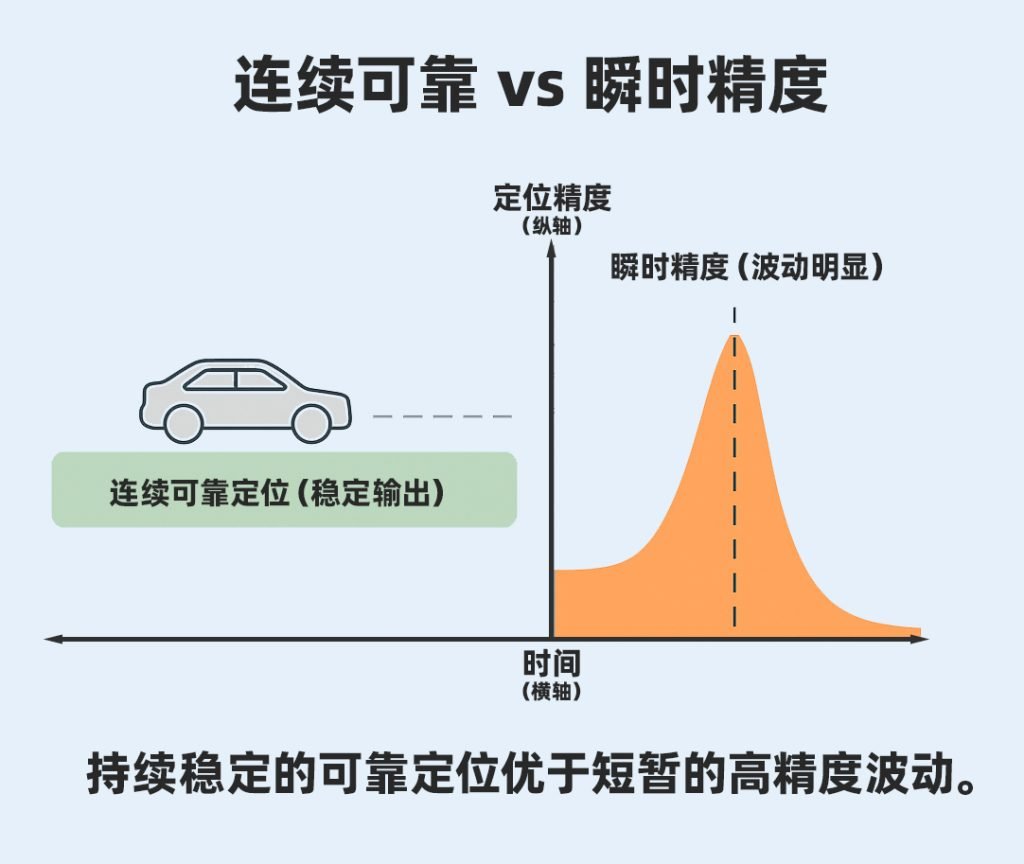
The drift that consumers see on a map is actually the result of an “instantaneous accuracy collapse” within the system.
For a human driver, this barely matters;
but for an autonomous driving system, it means a disconnect between perception and decision-making.
MOJANDA’s reliability is not about being most accurate at any single moment — it is about maintaining consistent, stable output for hours on end. This stability depends on:
- A precision temperature-compensated crystal oscillator (TCXO) keeping clock drift extremely low;
- Real-time updates to ephemeris correction models;
- Multi-source integrity monitoring algorithms continuously validating data validity in the background.
This is the true definition of reliability:
Not never making an error, but always being trustworthy.
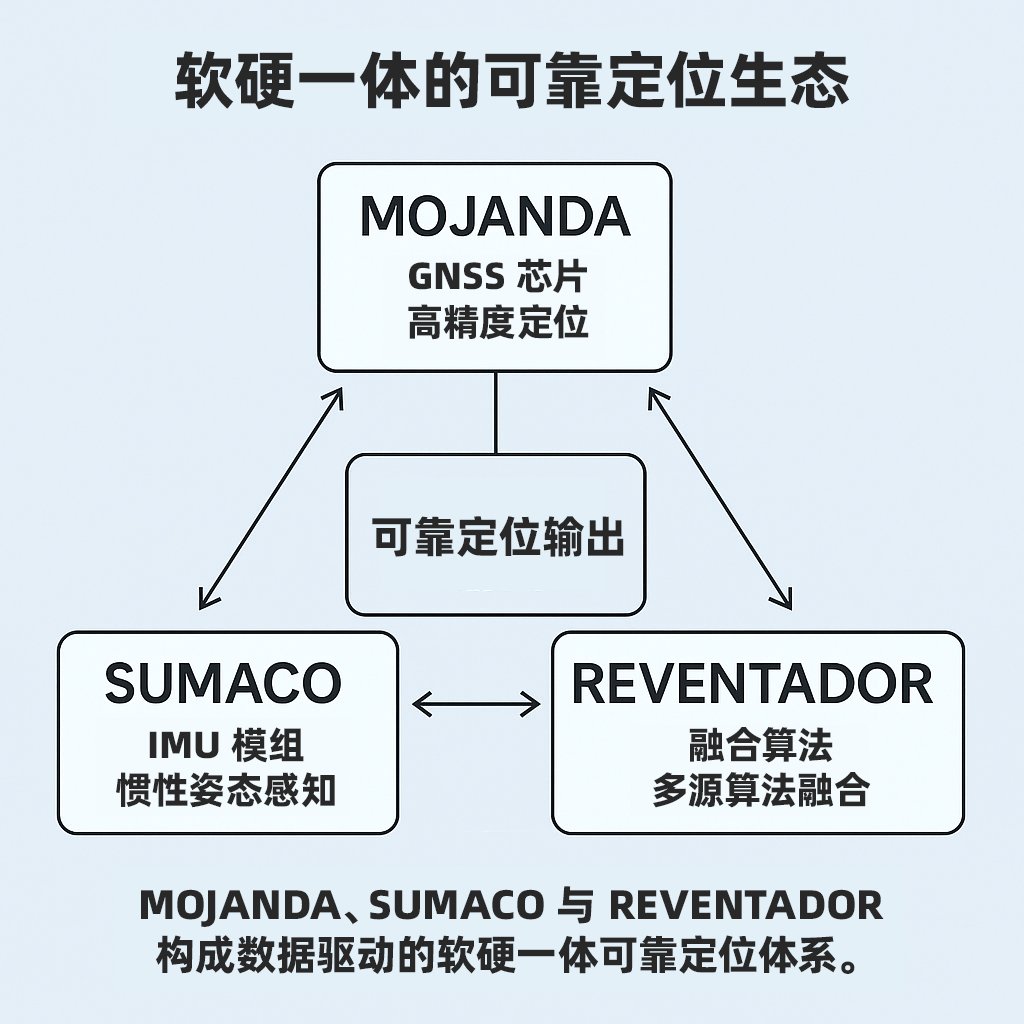
IV. The Reliable Positioning Ecosystem: When Chip and Algorithm Coexist
No matter how powerful a single chip may be, it cannot handle every complex environment on its own.
True “reliable positioning” is a systems engineering challenge.
MOJANDA’s strength lies in the fact that it is not an isolated product, but the cornerstone of an entire spatial intelligence architecture.
- Works in concert with the SUMACO IMU module to handle short-duration signal blockages;
- Integrates with the REVENTADOR sensor fusion platform for multi-source position solving;
- Supports OTA data updates, allowing algorithms to self-optimize as environments evolve.
The significance of this architecture is clear:
When conditions change and scenarios grow complex, the system dynamically adjusts weights to maintain solution stability.
It is a quintessential “data-driven, hardware-software integrated” approach —
the chip acts as the sensory organ, the algorithm as the nervous system, and data as the nourishment for learning.
V. Reflections and the Road Ahead
Over the past decade, the dominant theme in positioning technology has been “greater accuracy”;
in the decade ahead, the defining keyword will be “greater reliability.”
For embodied intelligence systems such as autonomous vehicles, drones, and robots,
reliable positioning is the prerequisite for action,
and data-driven reliability is the foundation of intelligent decision-making.
MOJANDA is not simply a hardware upgrade —
it is the first step toward making spatial intelligence truly dependable.
Accuracy tells a machine where it is. Reliability gives it the confidence to act.
Further Reading
- Paul D. Groves: GNSS and Vehicle Navigation Technologies
- Kaplan & Hegarty: Understanding GPS/GNSS: Principles and Applications
- Titterton & Weston: Strapdown Inertial Navigation Technology
About MCT
MCT (毫厘智能) is an innovative company focused on attitude sensing and absolute positioning for the era of Physical AI. With artificial intelligence at our core, we follow a “data-driven, hardware-software integrated” strategy to develop and deliver comprehensive attitude sensing and absolute positioning solutions — serving markets including embodied intelligence, urban-area assisted driving, low-altitude economy, robotics, and smart devices. Building on our proprietary automotive-grade BeiDou high-precision chips and modules, and combining high-precision IMU, vision, and LiDAR sensor technologies with large-scale data assets, MCT provides more reliable, safer, and more precise technical support for autonomous planning and automatic control, continuously enhancing the spatial perception capabilities of intelligent platforms.
Want to learn more about MCT’s latest developments? Visit www.mctech.ai / www.mctai.cn, or follow our WeChat official account: 毫厘智能 MCT.