MOJANDA | Multipath & Interference: Surviving the Urban Canyon

From afar to the finest margin — down to the last millimeter!
“A satellite signal is not light sent down from the heavens — it is a traveler worn down by the journey.”
I. Why Cities Make Satellites “Lose Their Way”
In open terrain, GNSS signal propagation is nearly ideal:
Satellites transmit from overhead, receivers pick up the signal directly,
and there is only one propagation path.
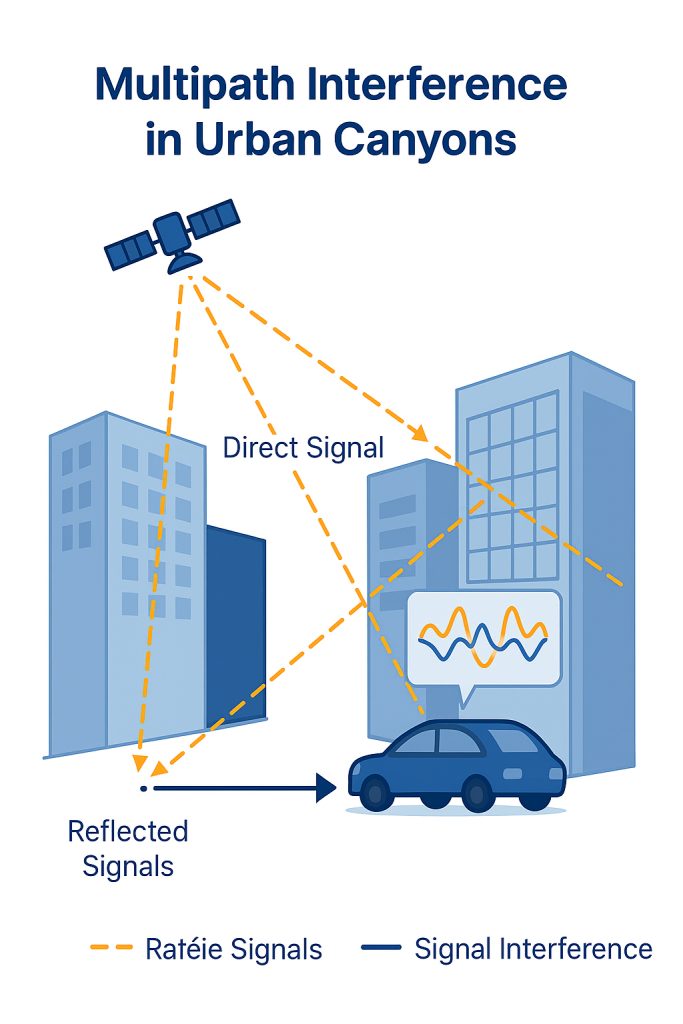
But step into a city center — surrounded by skyscrapers, glass curtain walls, digital billboards, and elevated highways — and satellite signals begin to reflect, diffract, and scatter off building surfaces.
The result:
The receiver no longer picks up only the line-of-sight signal,
but also multipath signals — echoes bounced off surrounding structures.
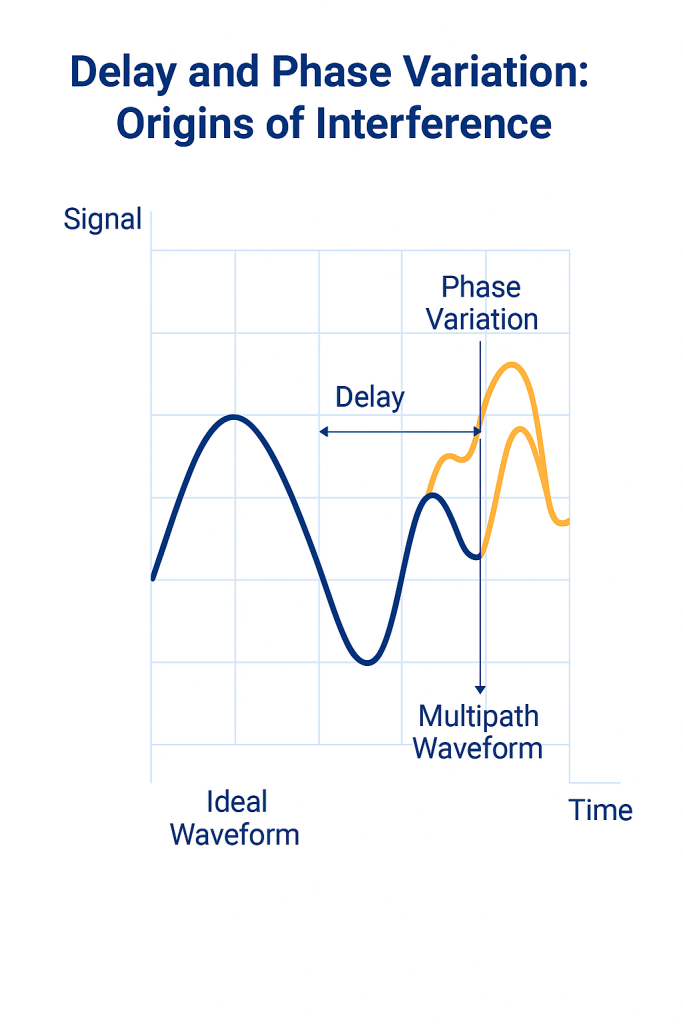
These multipath signals introduce time delays and phase distortions, which manifest in positioning as:
“You’re still on the road, but the system thinks you’ve already driven into a building.”
II. The Physics of Multipath and Interference
1️⃣ What is Multipath?
When a satellite signal encounters an obstacle — such as a wall, glass surface, or body of water — part of its energy is reflected back. The reflected path is longer, causing the signal to arrive with a delay, which leads the receiver to incorrectly conclude that the satellite is farther away than it actually is.
2️⃣ What is Interference?
Interference is not reflection — it is phase disruption caused by external electromagnetic noise or co-frequency signals. Common sources include:
- 5G base stations and communications transmitters;
- Spurious emissions from on-board radar and navigation equipment;
- Industrial noise and power supply harmonics.
Combined, these forces subject GNSS signals in urban environments to a triple threat: delay + frequency mixing + packet loss.
III. MOJANDA’s Response: An Algorithm-Level “Anti-Interference Neural System”
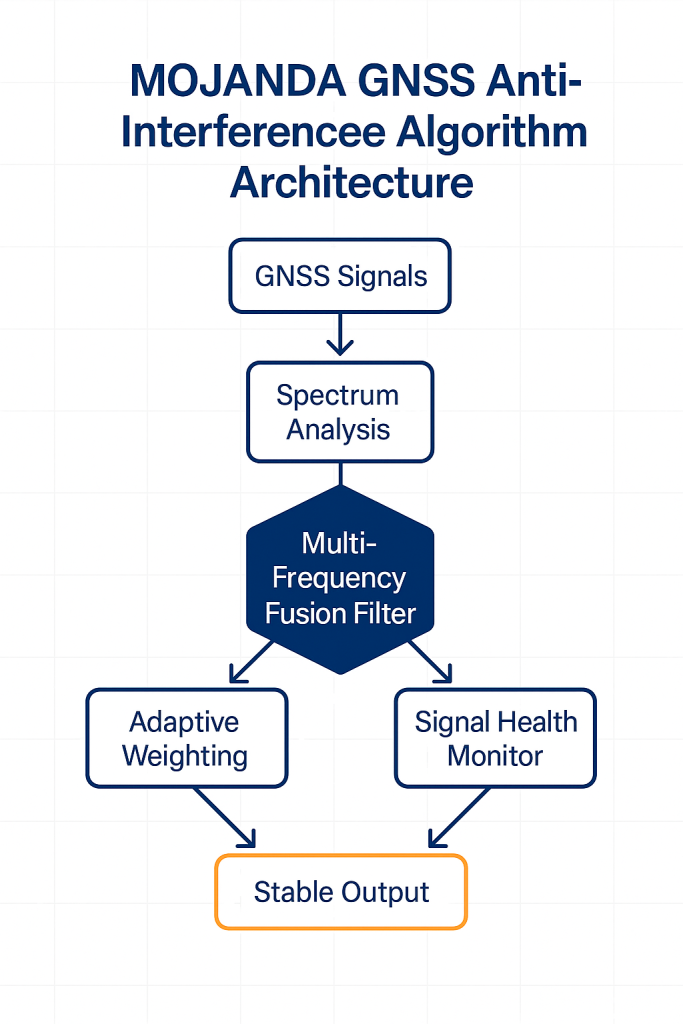
MOJANDA is not simply a signal receiver. It is built around a comprehensive anti-interference algorithm architecture that gives the system the ability to self-sense, self-correct, and self-recover.
1️⃣ Multi-Frequency Fusion Filtering
By performing phase-differential cross-validation across three frequency bands, the system identifies and attenuates the influence of multipath paths. Low frequencies ensure signal penetration, while high frequencies are used to detect and quantify reflection-induced errors.
2️⃣ Adaptive Signal Weighting
When the signal-to-noise ratio of a particular satellite or frequency band degrades, the system automatically reduces its weighting in the position solution, preventing corrupted signals from dominating the output.
3️⃣ Interference Detection and Suppression
FFT spectral analysis is used to detect anomalous energy peaks, and suspicious frequency bands are automatically blocked at the algorithm level — forming a real-time protective shield.
4️⃣ Signal Health Monitor
An onboard diagnostic module continuously monitors signal consistency and fluctuation rates, enabling detection of signal anomaly events within milliseconds.
This architecture enables MOJANDA to actively defend itself in urban environments — no longer a passive receiver, but a proactive guardian of signal integrity.
IV. Engineering Validation: From the Lab to the Urban Canyon
In MOJANDA’s engineering validation process,
anti-interference capability is not an abstract metric — it is rigorously measured.
- Multipath Simulation Testing: Signal simulators are used to construct virtual urban scenarios;
- Electromagnetic Compatibility (EMC) Testing: Verifies output stability under strong signal interference;
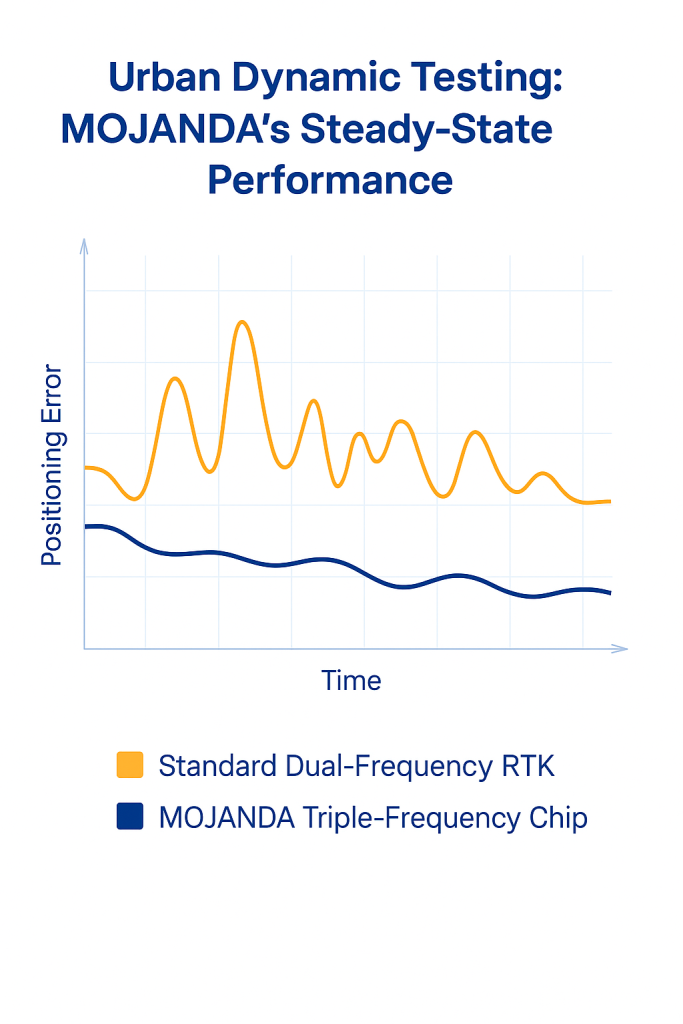
- Dynamic Drive Testing: Validates positioning continuity in elevated road, tunnel, and interchange environments;
- Environmental Robustness Testing: Assesses the impact of temperature and voltage fluctuations on signal lock.
Results demonstrate that MOJANDA reduces average positioning error in multipath environments by 42% compared to mainstream dual-frequency RTK modules, with signal recovery time shortened by 37%.
It doesn’t just resist interference in the lab — it survives in the real city.
V. Upholding Signal Integrity in a Complex World
Satellite signals traverse the atmosphere, the ionosphere, and dense urban structures
before finally reaching the receiver in your hands.
It is a long and fragile journey.
What MOJANDA does
is ensure that journey is no longer easily broken.
We don’t just pursue greater accuracy — we ensure that signals are respected, understood, and protected even in the most complex environments.
This is MCT’s engineering philosophy:
Finding truth in noise, and pursuing certainty amid chaos.
About MCT
MCT is an innovative company dedicated to attitude sensing and absolute positioning for the Physical AI era.
With artificial intelligence at its core, MCT employs a data-driven, hardware-software integrated strategy
to develop and deliver comprehensive attitude sensing and absolute positioning solutions,
serving the fields of embodied intelligence, urban assisted driving, low-altitude economy, robotics, and smart devices.
Built on proprietary automotive-grade BeiDou high-precision chips and modules,
MCT integrates high-precision IMU, vision, and LiDAR sensor technologies with large-scale data assets
to deliver more reliable, safer, and more precise technical support for autonomous planning and automatic control,
continuously enhancing the spatial awareness capabilities of intelligent platforms.
To learn more about MCT, visit www.mctech.ai / www.mctai.cn, or follow our WeChat Official Account: 毫厘智能 MCT.