MOJANDA | Chip-Level Reliability: The Validation Logic from Lab to Vehicle


I. From “Functional” to “Trustworthy”: What Automotive-Grade Really Means
In consumer electronics, a product only needs to “work.” In intelligent driving, a chip must be “trustworthy.” Being “trustworthy” means more than stable performance — it means reliability that is verifiable, traceable, and reproducible. This is the core of “Automotive-Grade”: maintaining continuous, stable, fault-free operation under extreme conditions including high temperature, low temperature, vibration, electromagnetic interference, and prolonged operation.
For MOJANDA, reliability is not an afterthought tested at the end — it is a systemic discipline embedded from the very first stage of design. Every chip, from wafer-level validation to vehicle integration, undergoes layer upon layer of rigorous evaluation. It is not merely a “calculator” — it is a “pilot” forged through the most demanding training.

II. AEC-Q100/Q104: The Standard Language of Chip Reliability
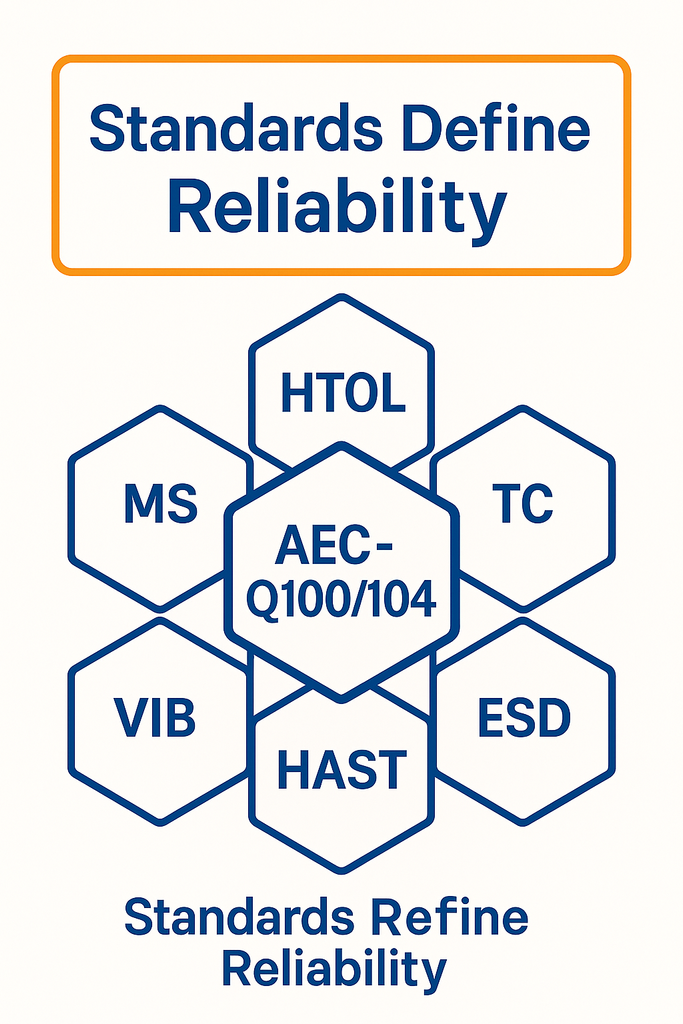
“Automotive-grade” is not a marketing slogan — it is defined by rigorous standards. AEC-Q100 is the qualification standard for automotive-grade IC chips, while AEC-Q104 applies to multi-chip module packages (such as the MOJANDA M1 series). Together, they govern the complete process from design and qualification to burn-in and stress testing.
Key tests include:
- High Temperature Operating Life (HTOL): Simulates 1,000 hours of continuous operation at elevated temperatures;
- Temperature Cycling (TC): 1,000 repeated cycles between -40°C and +125°C;
- Mechanical Shock (MS) and Vibration (VIB): Validates solder joint reliability under mechanical stress;
- Highly Accelerated Stress Test (HAST): Assesses sealing integrity and material stability under high humidity.
Through these tests, every parameter and every bond wire of the chip is quantitatively verified. MOJANDA has completed the full qualification process through SGS, an accredited third-party certification body, and has officially obtained AEC-Q100 Grade 2 certification — confirming reliable operation across a temperature range of -40°C to +105°C.
III. From Lab to Vehicle: Five Lines of Validation Defense
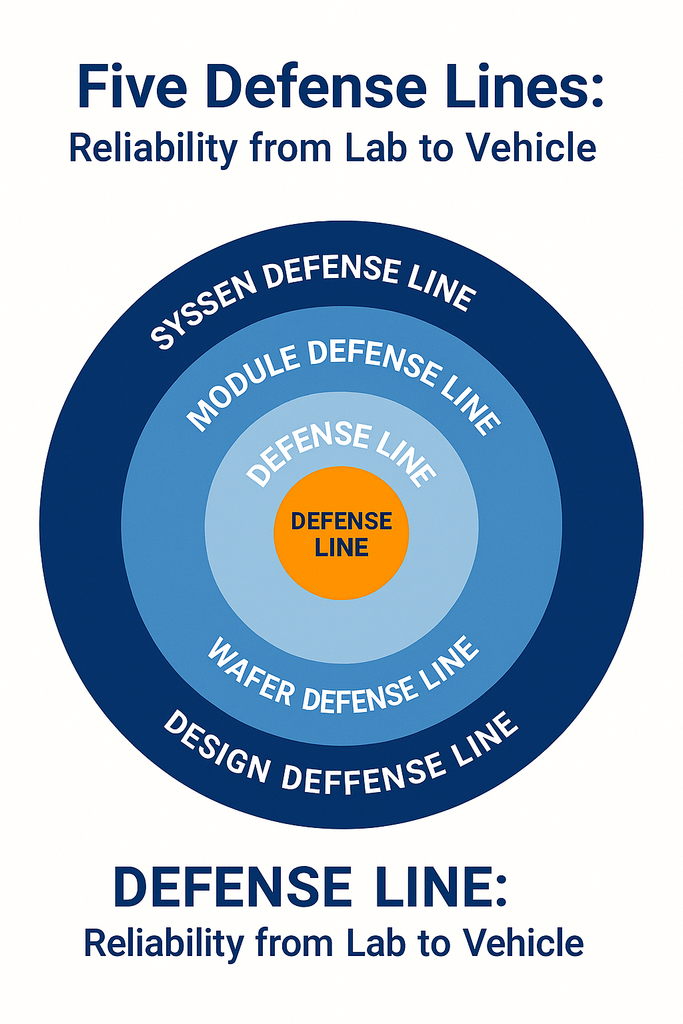
MOJANDA’s validation framework adopts a “Five Lines of Defense” model, ensuring every stage is fully traceable:
- Design Defense: Automotive-grade IP libraries and redundant design architectures are employed to minimize single points of failure.
- Wafer Defense: Wafer Acceptance Testing (WAT) screens out early defects and ensures consistent yield stability.
- Package Defense: Automotive-grade lead materials and moisture-resistant packaging processes are used, with MSL3 qualification achieved.
- Module Defense: Module-level validation is conducted for thermal cycling, vibration, and thermal shock.
- System Defense: EMC, power fluctuation, and communication fault testing are performed in real vehicle environments.
These five lines of defense form a complete closed loop spanning Design → Manufacturing → Packaging → Validation → Vehicle Integration,
enabling every chip to operate reliably over the long term in the harshest real-world conditions.
IV. Reliability Is More Than Passing a Test
At MCT, reliability is not a one-time milestone — it is a continuously evolving process. Through a data-driven quality traceability system, the test data, process parameters, and in-vehicle performance of every MOJANDA chip are recorded and fed back into the design and production cycle.
This means product reliability is not a static checkpoint, but a dynamic, iterative improvement:
- Long-term operational data is used to predict potential aging trends;
- Algorithmic analysis drives optimization of subsequent batch designs;
- Production traceability establishes a data closed loop from wafer lot number to vehicle VIN.
This is what MCT means by “data-driven reliability” —
making reliability not just a promise, but a systemic capability.

V. When Reliability Becomes Trust
Reliability is the foundation of technology — and the starting point of trust.
In the world of automotive-grade GNSS chips,
every cold start, every signal acquisition, is a proof point of systems engineering excellence.
Through chips that operate with unwavering stability, MOJANDA transforms “reliability” from a lab specification
into a lived experience — in every vehicle on the road, every drone in the sky, every robot in operation.
About MCT
MCT is an innovative company focused on attitude sensing and absolute positioning for the Physical AI era. With artificial intelligence at its core, MCT adopts a “data-driven, software-hardware integrated” strategy to develop and deliver comprehensive attitude sensing and absolute positioning solutions, serving fields including embodied intelligence, urban assisted driving, low-altitude economy, robotics, and intelligent devices. Built on its proprietary automotive-grade BeiDou high-precision chips and modules, MCT fuses high-precision IMU, vision, and LiDAR sensor technologies with large-scale data to provide more reliable, safer, and more precise support for autonomous planning and automated control — continuously enhancing the spatial awareness capabilities of intelligent platforms.
Want to stay up to date with the latest from MCT?
Visit www.mctech.ai / www.mctai.cn, or follow our WeChat Official Account: “毫厘智能 MCT”.