MOJANDA | Anti-Jamming & Multipath Mitigation: Maintaining Signal Integrity Through the Noise

From Afar to the Millimeter
1️⃣ “Ghost Signals” in the Urban Canyon
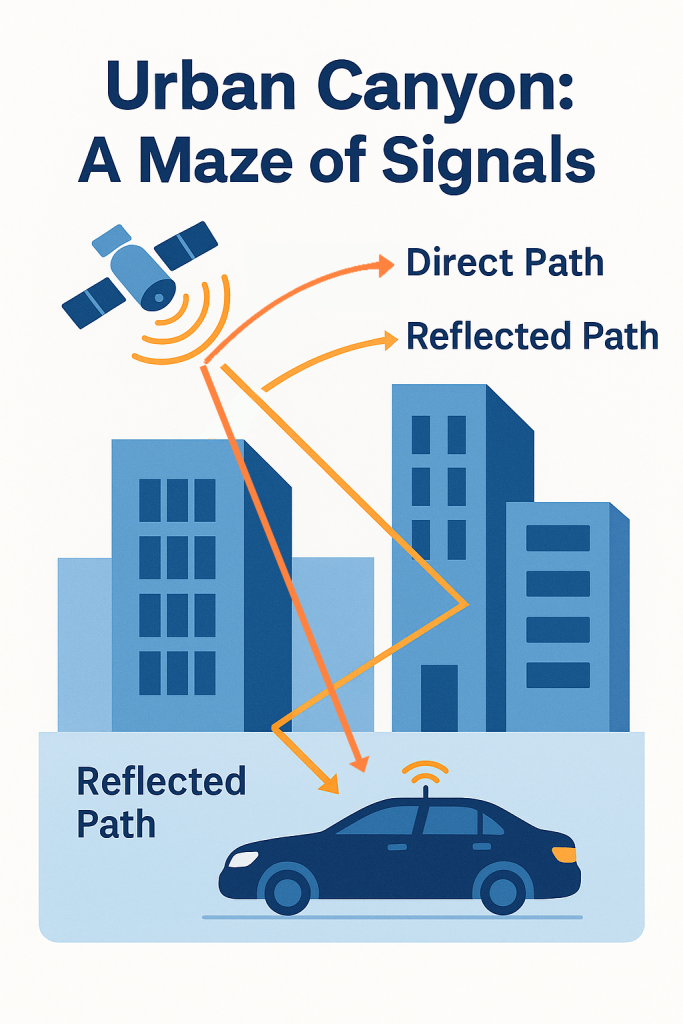
When a vehicle navigates through a dense urban environment, GNSS signal paths are anything but straight. Signals transmitted from satellites travel through the atmosphere and then bounce off glass curtain walls, metal structures, and even the ground. Some signals arrive directly at the receiving antenna, while others take a longer, reflected path before arriving — this is the Multipath Effect. In positioning calculations, these “detoured” signals overlap with direct-path signals, and combined with ambient electromagnetic interference, they present the system with a blurred, drifting picture of the world.
A simple analogy:
Imagine shouting across a valley — your voice and its echo arrive together. Without the right algorithm to separate them, what you hear is a distorted version of yourself.
2️⃣ The Nature of Multipath: Phase, Amplitude, and Timing Displacement
Every multipath signal exhibits three types of distortion:
- Propagation delay: The reflected path is longer, causing the signal to arrive later than expected;
- Phase shift: Reflection alters the waveform phase, introducing carrier-phase errors;
- Amplitude variation: Partial energy attenuation or constructive interference distorts the pseudo-random code.
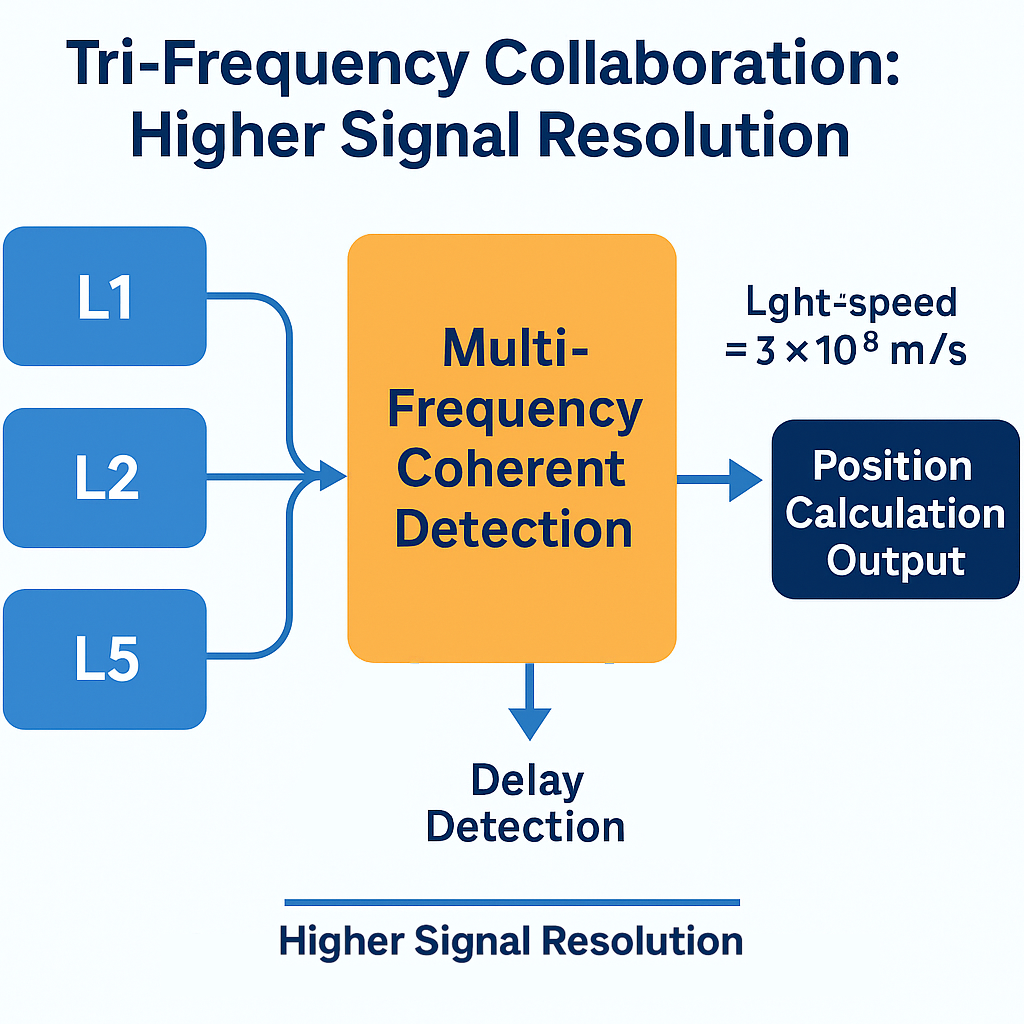
MOJANDA employs multi-frequency observation and coherent detection technology:
- Simultaneous observation of the same satellite signal across L1, L2, and L5 frequencies;
- Coherent integration to characterize signal delay signatures.
The result: even when the direct-path signal is temporarily obstructed, the chip can recover its positioning solution from the remaining frequency channels, maintaining stable centimeter-level accuracy.
3️⃣ Anti-Jamming: Bringing Clarity to a Noisy World
GNSS interference falls into two categories:
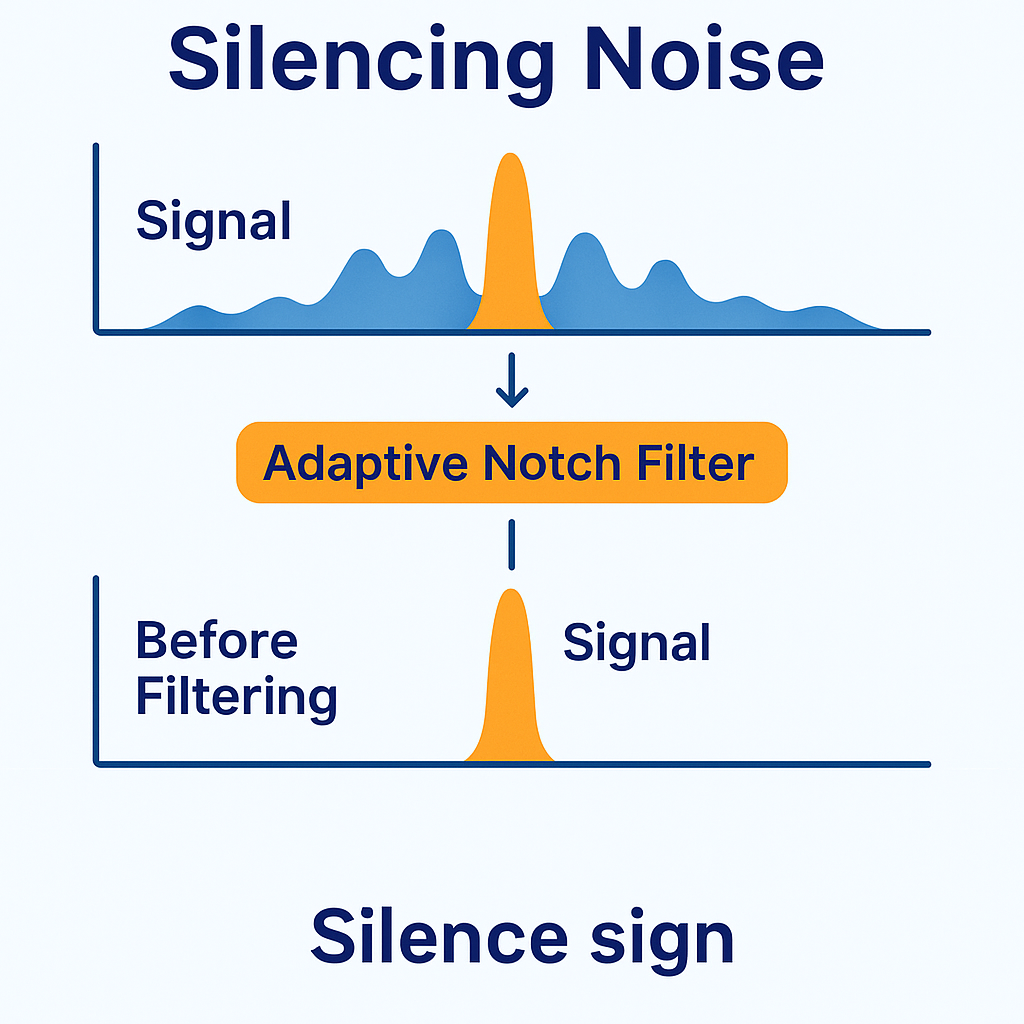
- Narrowband interference: High-energy signals concentrated at specific frequency points, like a piercing single tone;
- Broadband interference: Spectrally distributed across a wide range, like a wall of noise covering multiple signal channels.
The MOJANDA chip uses adaptive spectral analysis and a dynamic Adaptive Notch Filter to detect interference sources and their energy distribution in real time, applying targeted suppression to affected frequency bands. Under heavy jamming conditions, a signal resampling mechanism ensures continuity of the positioning solution.
This means that even in complex environments — surrounded by construction equipment, cellular base stations, or airport electromagnetic interference — the system can still “hear” the true satellite signal.
4️⃣ The Core of Reliability: Signal Quality Monitoring (SQM)
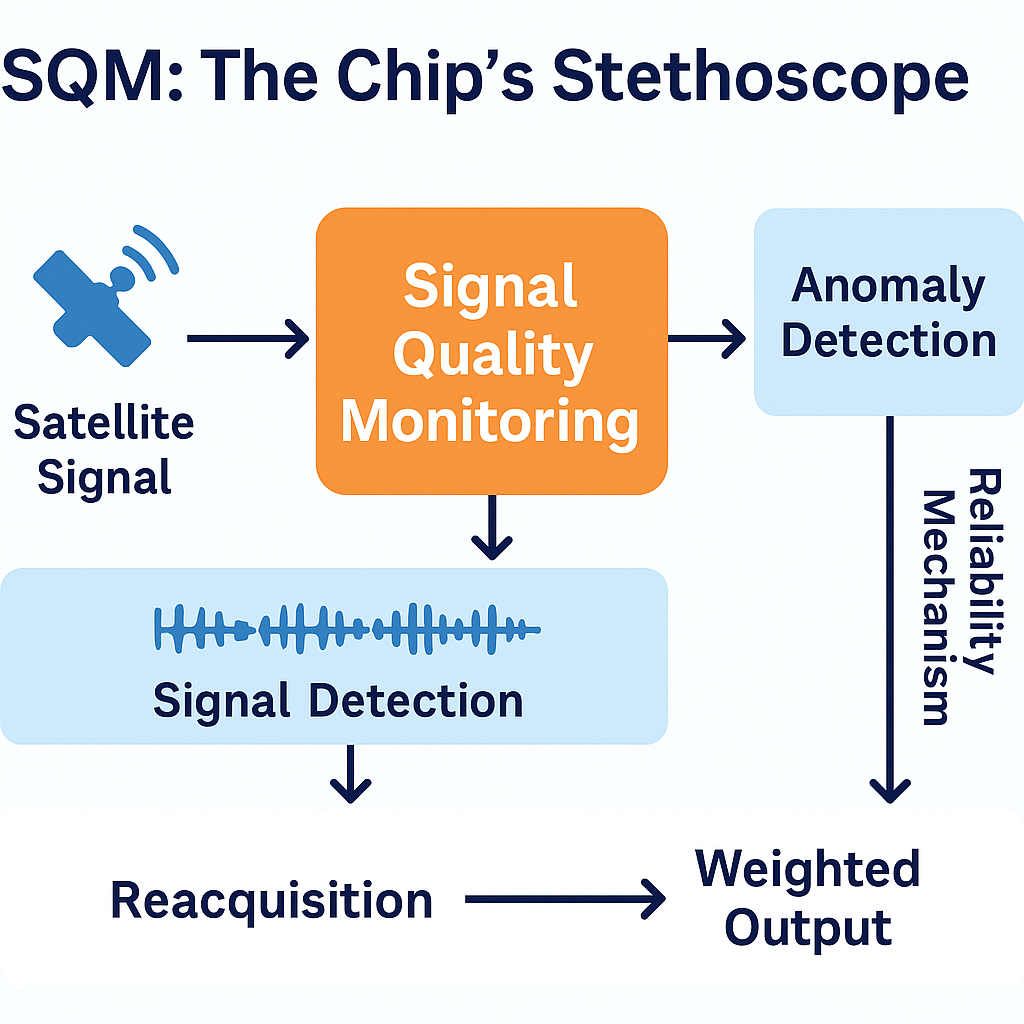
If anti-jamming is about eliminating noise, then SQM (Signal Quality Monitoring) is about diagnostics. MOJANDA integrates a multi-dimensional signal quality monitoring module that continuously analyzes signal strength, signal-to-noise ratio, phase residuals, and other parameters to detect anomalous waveforms or sudden phase jumps. Upon detecting a false lock or multipath contamination, the system immediately triggers a self-recovery routine, using weight adjustment and re-acquisition mechanisms to ensure output integrity.
This is what sets an automotive-grade chip apart from a standard consumer-grade chip: the former must always know whether it has heard correctly.
5️⃣ Maintaining Signal Through the Noise: Why Stability Matters
Anti-jamming is not about shutting out the world’s chaos;
it is about keeping the system clear-headed in the midst of it.
That is precisely what MOJANDA is built for —
in the most complex urban environments, under the harshest electromagnetic noise conditions,
it continues to deliver a stable, continuous, and trustworthy world coordinate.
About MCT
MCT is an innovative company focused on attitude sensing and absolute positioning for the Physical AI era. With artificial intelligence at its core, MCT follows a “data-driven, hardware-software integration” strategy to develop and deliver comprehensive attitude sensing and absolute positioning solutions — serving markets including embodied intelligence, urban-area assisted driving, low-altitude aviation, robotics, and intelligent devices. Built on proprietary automotive-grade BeiDou high-precision chips and modules, MCT fuses high-precision IMU, vision, and radar sensor technologies with large-scale data to provide more reliable, safer, and more accurate support for autonomous planning and automated control, continuously advancing the spatial perception capabilities of mobile platforms.
Want to learn more about MCT and our latest developments?
Visit www.mctech.ai / www.mctai.cn, or follow our WeChat Official Account: “毫厘智能 MCT”.