MOJANDA 330 Wins 2025 Linxuan Award for Automotive Chips, Setting a New Benchmark in Triple-Frequency Automotive-Grade Positioning

On December 6th in Fenhu, Suzhou, at the 10th Linxuan Awards ceremony, MCT’s self-developed automotive-grade triple-frequency high-precision GNSS chip MOJANDA 330 was honored with the “2025 10th Linxuan Award · Forward-Looking · Automotive Chip Category Excellence Award” (hereinafter referred to as the “Linxuan Award for Automotive Chips”). MCT CEO Li Ke accepted the award on behalf of the team. This recognition affirms that MOJANDA 330 has achieved authoritative industry validation in automotive-grade reliability, indigenous innovation capability, and its value to the intelligent driving industry.
As one of China’s most influential annual awards in the automotive supply chain, the Linxuan Award has, over its ten-year history, brought together leading industry players including Momenta, Li Auto, Horizon Robotics, ZF, Hesai Technology, and Jideco, among others — serving as a key reference framework for OEMs evaluating core supply chain capabilities. MOJANDA 330’s recognition marks a milestone breakthrough for domestically developed automotive-grade high-precision positioning chips in both technological advancement and industrialization maturity.
Triple-Frequency Automotive-Grade Positioning Ushers High-Precision Navigation into a New Application Era
Designed for scenarios with the highest reliability demands — including intelligent vehicles, robotics, UAVs, and agricultural autonomous driving — MOJANDA 330 employs a multi-constellation, multi-frequency fusion architecture that enables a generational leap from single- and dual-frequency to the “triple-frequency era.” It delivers stable, continuous centimeter-level positioning performance in challenging environments such as urban signal blockage, weak signal conditions, and high-interference settings.
The chip supports all major satellite systems including BeiDou, GPS, GLONASS, Galileo, and QZSS, and is compatible with multiple positioning modes including PVT, RTK, and PPP. Built on a high-performance RF front-end and an optimized baseband architecture, MOJANDA 330 excels in weak-signal tracking, concurrent multi-satellite processing, and robustness in complex electromagnetic environments — providing intelligent driving systems with a reliable spatial positioning foundation for environment perception, path planning, and control execution.
At the system architecture level, MOJANDA 330 adopts a custom RISC-V processing architecture, delivering approximately a 10x efficiency improvement over conventional solutions, and supports fast wake-up in approximately 10 microseconds (10 µs) — enabling a better balance between real-time responsiveness and power consumption in autonomous driving scenarios, while preserving ample compute and response headroom for upper-layer fusion algorithms and control systems. This demonstrates that triple-frequency positioning capability has achieved automotive-grade data reliability, laying a critical foundation for continuous positioning, precise environmental understanding, and large-scale deployment in factory-installed intelligent driving systems.
Full Automotive-Grade Reliability Framework Established, Mass Production Scalability Validated by OEMs
MOJANDA 330 has been developed in full compliance with automotive-grade standards across the entire flow — from architectural design and front-/back-end implementation to system verification. The chip has passed AEC-Q100 Grade 2 certification and demonstrated consistent stability across multiple automotive-grade qualification items including thermal cycling, lifetime testing, and stress tests, meeting the long-term consistency and extreme operating condition requirements of OEM factory-installed mass production programs.
On the R&D and manufacturing side, MCT has built full-stack in-house capabilities spanning RF, analog, SoC, baseband, and algorithms — combined with automotive-grade design methodology, verification processes, and supply chain management — achieving deep end-to-end autonomy from design to process. In mass production, MOJANDA 330 has established a stable and scalable automotive-grade production system, with DFT coverage reaching 99.8% and chip design PPM <30, meeting international best-in-class standards, ensuring both yield and consistency at volume, and providing strong assurance for large-scale OEM customer ramp-up.
Following rigorous functional, reliability, and system integration validation by OEM partners, MOJANDA 330 has been awarded full-platform design wins with OEMs and is on track for mass production launch by the end of 2025. This not only substantially improves navigation quality in complex road conditions and high-dynamic environments, but also drives high-precision positioning from “niche application” to “industry-wide adoption” — laying the groundwork for scaled deployment in intelligent driving, robotics, and the low-altitude economy.
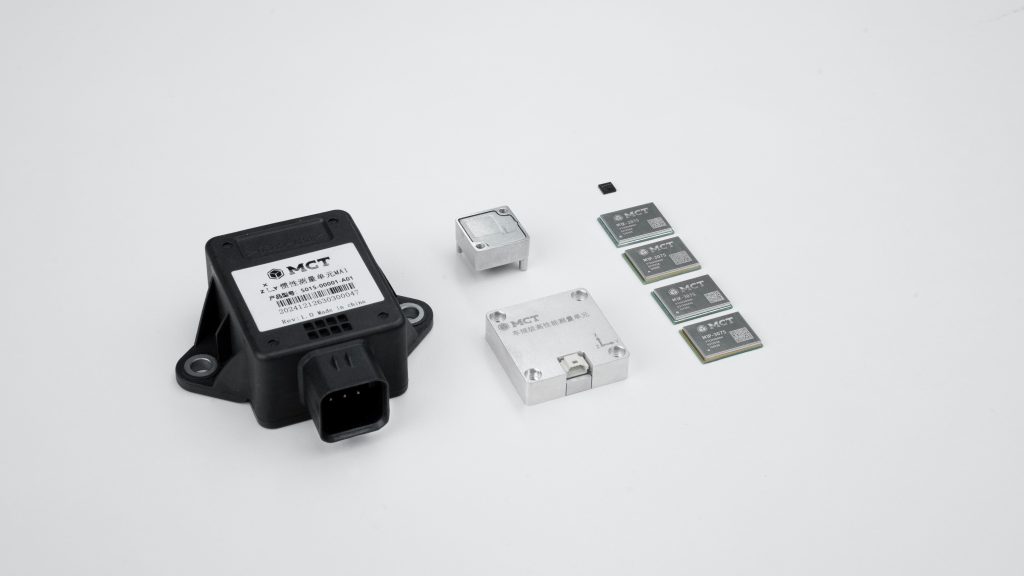
Data-Driven × Hardware-Software Integration: Building the Foundation for Spatial Intelligence
MCT noted that MOJANDA 330’s award represents a key milestone in the company’s “data-driven, hardware-software integrated” strategy. Looking toward the coming era of AI-powered spatial intelligence, the company is building a core capability framework centered on:
- MOJANDA (High-Precision Positioning)
- SUMACO (Automotive-Grade Attitude Sensing)
- REVENTADOR (Fusion Computing and Data Engine)
These three pillars address positioning, attitude sensing, and multi-source fusion respectively, together forming a “Spatial Intelligence Foundation” purpose-built for intelligent driving, embodied AI, unmanned systems, and industry applications.
Going forward, MCT will continue to invest in GNSS, IMU, fusion algorithms, and data platforms — collaborating with industry partners to drive the scaled adoption of spatial intelligence across intelligent vehicles, robotics, and the low-altitude economy, making reliable spatial data a true foundational force for industrial progress and application innovation.