MCT’s MOJANDA 330 and MOJANDA 320 Selected for the 2026 China Automotive Chip Supply Handbook
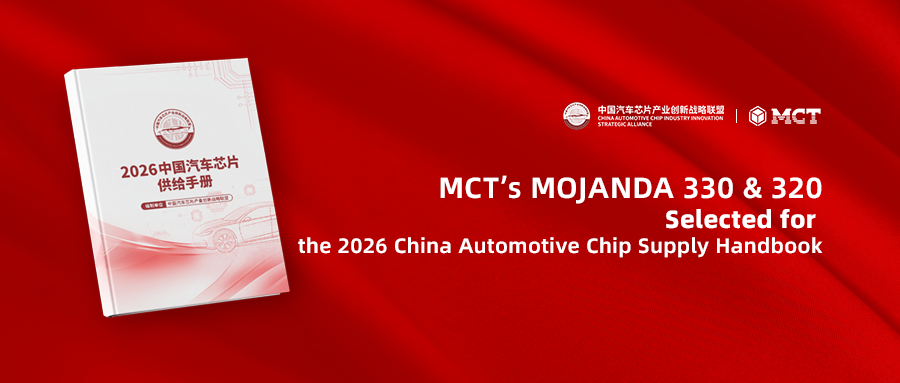
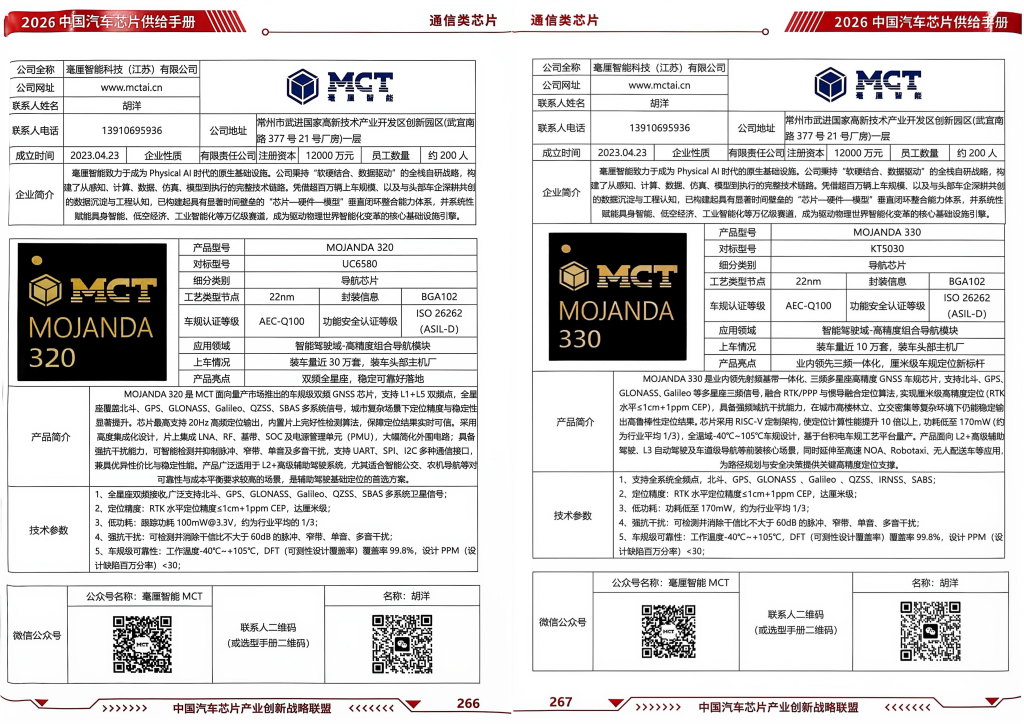
The 2026 China Automotive Chip Supply Handbook has officially been released, with MOJANDA 330 and MOJANDA 320, two automotive-grade GNSS chips independently developed by MCT, both selected for inclusion.
Behind the recognition of both chips is MCT’s established capability across in-house R&D, automotive-grade validation, and large-scale production.
From proprietary chip design and automotive-grade productization to scaled deployment in real vehicle programs, MCT continues to bring domestically developed high-precision positioning chips into broader use—at scale, with sustained delivery, and with capabilities proven through real-world operation.
Advancing with Two Chips, Building a Broader Automotive-Grade GNSS Portfolio
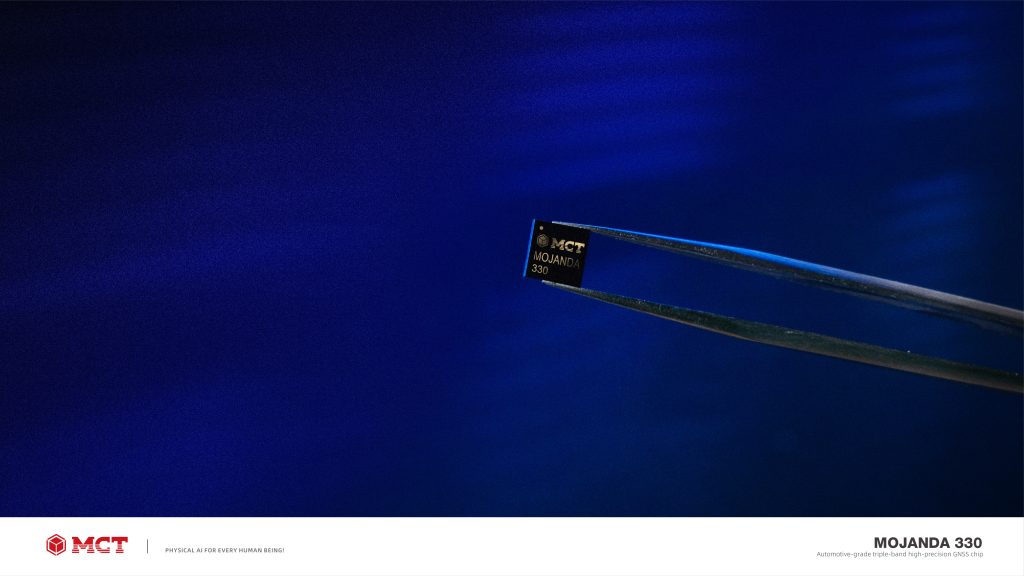
MOJANDA 330 and MOJANDA 320 are designed respectively for triple-frequency and dual-frequency automotive-grade high-precision GNSS applications.
MOJANDA 330 supports multi-constellation, triple-frequency GNSS, with high-precision positioning capabilities including RTK and PPP, as well as integrated inertial navigation applications. MOJANDA 320 targets mainstream dual-frequency automotive applications, delivering a balanced combination of high-precision positioning performance, power efficiency, and interference resistance.
Both chips are manufactured on a 22 nm process, meet AEC-Q100 automotive-grade requirements, and support ISO 26262 ASIL-D functional safety requirements. They are designed for applications including high-precision integrated navigation for intelligent driving.
From dual-frequency to triple-frequency solutions, MCT is building a proprietary GNSS chip portfolio for a broad range of automotive-grade high-precision positioning requirements.
Moving from chip design to large-scale production requires automotive-grade validation, system integration, production launch, quality management, and sustained delivery. The MOJANDA family is advancing along this full path from proprietary development to scaled industrial adoption.
From Product-Level Impact to Scalable Supply Capability
In April this year, at the “China Chip” pavilion during the Beijing Auto Show, MOJANDA 330 was named a “2026 Influential Automotive Chip” at the 2026 China Automotive Chip Industry Innovation Achievement Awards.
The award recognizes domestically developed automotive chips already in mass-production applications, with evaluation criteria covering technological advancement, product innovation, market performance, and customer adoption.
The subsequent inclusion of both MOJANDA 330 and MOJANDA 320 in the 2026 China Automotive Chip Supply Handbook further demonstrates how MCT’s automotive-grade GNSS capability is evolving from the strength of an individual product into a broader product portfolio with scalable supply capability.
In automotive semiconductors, localization is ultimately proven in mass production.
MCT follows a technology strategy of “hardware-software integration, data-driven development”, while continuously strengthening its vertically integrated “chip–hardware–model” capability.
To date, MCT’s automotive-grade products have achieved cumulative deployment of more than one million units and have been continuously tested across over 5 billion kilometers of real-world driving.
Through long-term co-development with leading automakers, MCT continues to deepen its capabilities in chip design, system engineering, quality systems, and large-scale delivery.
For domestically developed automotive chips, the real test is moving from R&D to scaled deployment.
The inclusion of MOJANDA 330 and MOJANDA 320 represents another industry validation of MCT’s scalable supply capability in automotive-grade GNSS chips.
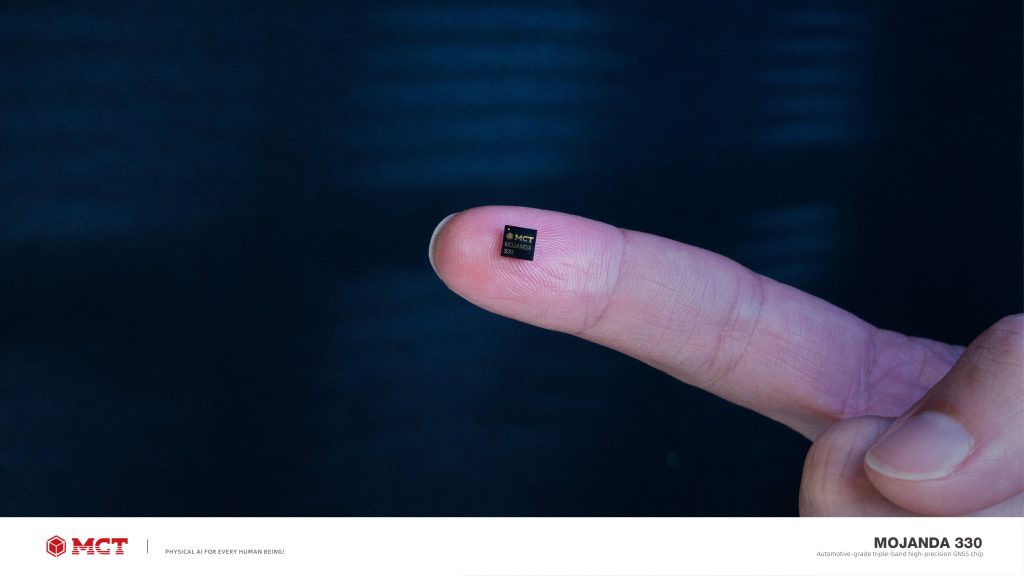
From Automotive-Grade Mass Production to the Broader Physical AI World
The automotive industry is one of the earliest Physical AI sectors to achieve large-scale operation in the real world, placing exceptionally high demands on safety, reliability, scalable manufacturing, and long-term data closed loops.
Years of deep engagement in the automotive sector have enabled MCT to undergo the systematic tests required for Physical AI technologies to move toward large-scale deployment, while accumulating real-world data, engineering know-how, and mass-production methodologies.
Building on these foundations, MCT continues to follow its “hardware-software integration, data-driven development” strategy, advancing a complete technology chain spanning perception, computing, data, simulation, models, and execution, and extending methodologies proven through large-scale production into a broader range of Physical AI applications.
The inclusion of MOJANDA 330 and MOJANDA 320 marks a milestone in the development of MCT’s proprietary chip capabilities, and another concrete step as MCT works toward becoming native infrastructure for the Physical AI era.