MCT at 2025 ADAS Conference: What Attitude Sensing and Absolute Positioning Does the VLA Era Demand?
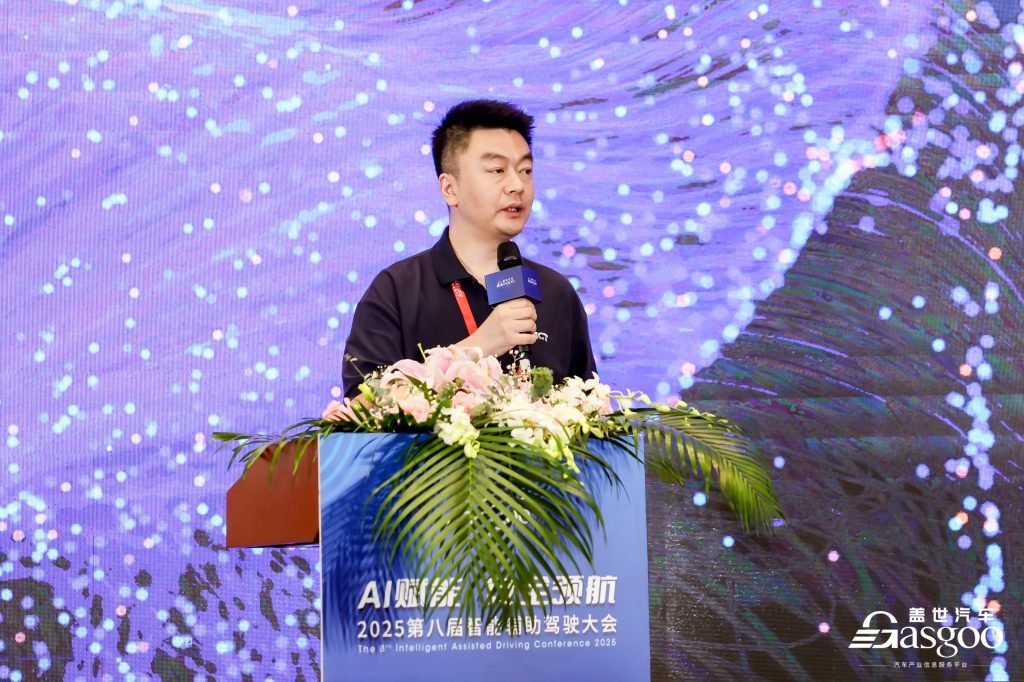
On July 22, 2025, MCT was invited to attend the “2025 8th Intelligent Driver Assistance Conference · Perception Fusion Forum,” hosted by Gasgoo. MCT’s Business Director Hu Yang delivered a keynote speech titled “Hardware-Software Integration and AI Empowerment: Enabling Reliable and Trustworthy Attitude Sensing and Absolute Positioning for the VLA Era.” Addressing the core challenges of intelligent driving perception systems, he presented MCT’s integrated hardware-software capabilities in combined navigation solutions, emphasizing: “Reliable perception will become the foundational enabler for the continued evolution of future intelligent driving architectures.”
From Immediate Necessity to Future Foundation: The Importance of Attitude Sensing and Absolute Positioning
As urban assisted driving continues to mature and expand, a system’s ability to answer two fundamental spatial questions — “Where am I?” and “Which direction am I facing?” — directly impacts overall vehicle reliability and decision-making safety. GNSS signals are frequently obstructed in high-density urban environments, making it difficult for traditional perception methods to ensure continuous computation of position and attitude. Meanwhile, intelligent driving systems are advancing beyond image recognition and control response toward a new stage of multimodal understanding and autonomous behavior planning.
In this context, attitude sensing and absolute positioning have become the foundational capabilities underpinning the stable operation of intelligent driving architectures. Hu Yang noted that the VLA (Vision-Language-Action) architecture integrates visual perception, language understanding, and action generation — and the prerequisite for its intelligent behavior is a continuous, stable input of spatial state data.
In this process, the synergy between IMU and GNSS becomes critical to ensuring system reliability:
- IMU ensures local continuity — maintaining stable dead-reckoning of position and attitude even in signal-denied environments;
- GNSS provides global consistency for spatial awareness — delivering precise absolute positioning whenever satellite signals are available;
Together, their fusion forms a stable, continuous multi-source perception input framework, equipping AI systems with reliable spatiotemporal understanding.
Three Integrated Platforms for a Reliable Perception System
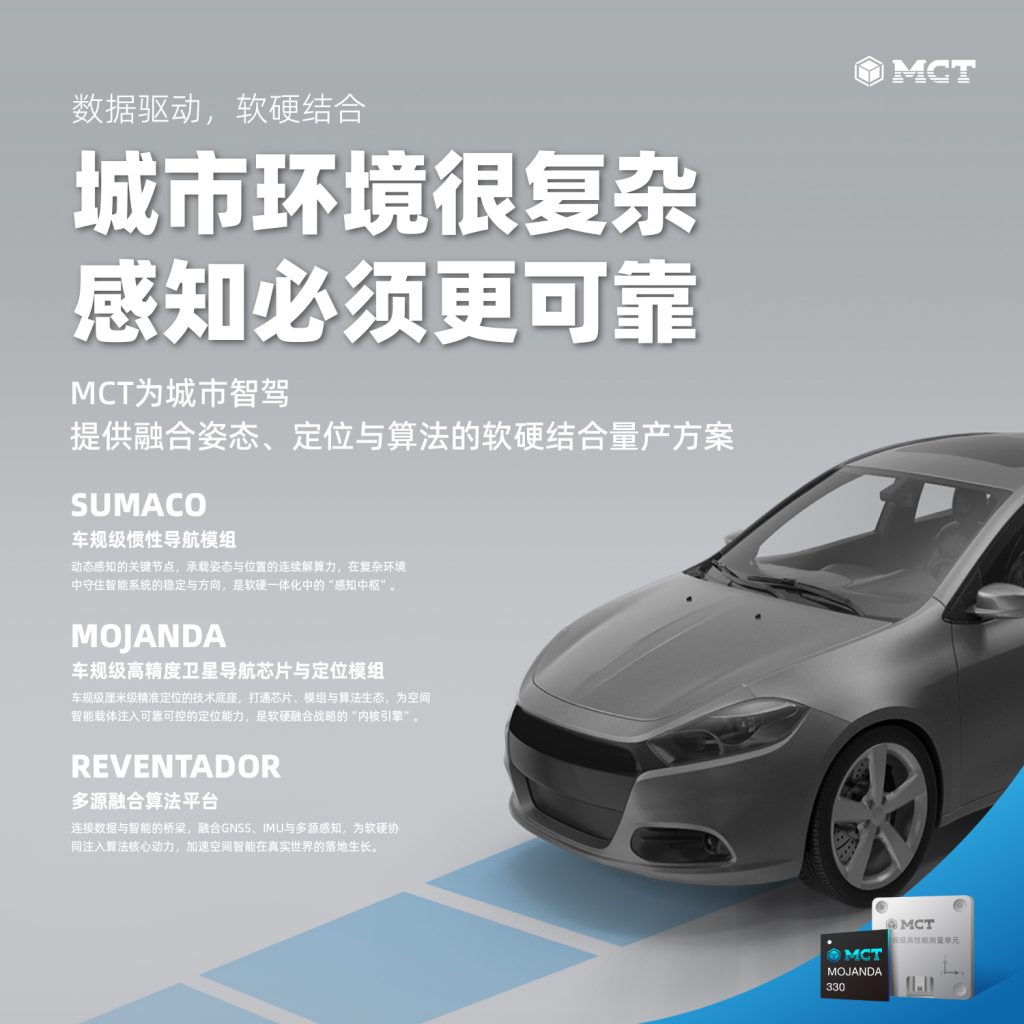
To address industry-wide challenges such as perception discontinuity, scene-based failure modes, and deployment complexity, MCT has built a combined navigation solution anchored by three core product pillars: an inertial module, a satellite positioning module, and an algorithm platform. Together, they deliver hardware-software co-optimization from the component level to the system level, forming a closed-loop “reliable perception” technology framework.
- SUMACO | Automotive-Grade Inertial Navigation Module
The critical node for dynamic perception, delivering continuous computation of attitude and position.
The SUMACO series supports multiple deployment configurations — including standalone ECU, IMU BOX, and domain controller integration — featuring high-frequency output, automotive-grade stability, and full-temperature-range calibration. It has secured platform-level production nominations from multiple OEMs.
- MOJANDA | Automotive-Grade High-Precision GNSS Chip and Positioning Module
The technological core of automotive-grade centimeter-level positioning, bridging the chip, module, and algorithm co-development pipeline.
The MOJANDA automotive-grade chip supports tri-frequency GNSS and raw observation output, with compatibility for RTK, PPP, and INS fusion algorithms. It offers high integration density, low power consumption, and domestic supply chain controllability, and has been widely deployed across production platforms.
- REVENTADOR | Multi-Source Fusion Algorithm Platform
The bridge between data and intelligence — fusing GNSS, IMU, and multi-source perception inputs to inject algorithm-driven capability into the hardware-software stack.
The platform supports satellite positioning, tight coupling, deep coupling, and multi-source fusion, enabling stable computation from PVT to INS across complex scenarios. Combined with a proprietary toolchain, it enables modular tuning and efficient deployment.
“Reliability” Is Not Just Accuracy — It’s Sustained Stability
Hu Yang emphasized that MCT’s definition of “reliability” goes beyond leading performance on any single accuracy metric — it encompasses the stability, adaptability, and sustainability of the full-stack engineering system. In addition to conventional metrics such as CEP68 and CEP95, MCT continuously develops evaluation frameworks in real-world projects that more accurately reflect true operating conditions, used to validate combined navigation system performance at the limits of challenging environments.
Real-world project test results demonstrate the MCT solution’s strong performance across critical scenarios:
- In tunnel environments, positioning error is controlled within 0.2%;
- In open-sky conditions, RTK fix rate consistently exceeds 99%;
- In urban canyon and underground environments, the system still achieves rapid initialization and stable sensor fusion.
The combined navigation solution is already deployed in production across multiple OEM platforms, supporting highly reliable operation of L2+, NOA, and robotics applications in complex urban environments.
Enabling AI Perception and Decision-Making: Giving Systems Spatial Awareness
From perceiving objects to understanding space, intelligent driving is steadily advancing toward the era of true “embodied intelligence.” Attitude sensing and absolute positioning will serve as the spatial gateway through which AI systems comprehend the world.
MCT will continue to advance its strategy of “data-driven, hardware-software integration,” evolving its two core capabilities — positioning and attitude — and delivering full-stack combined navigation solutions that provide stable spatial state inputs for reliable AI architecture operation, driving spatial intelligence from the lab into the real world.